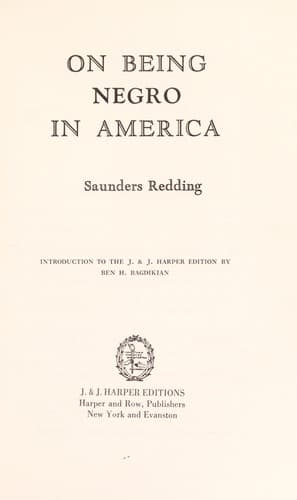
On Being Negro in AmericaRedding, J. Saunders (Jay Saunders)
General
On Being Negro in America
Redding, J. Saunders (Jay Saunders)
African Americans -- Race identity; Redding, J. Saunders (Jay Saunders), 1906-1988; United States -- Race relations
The first who came was a moist, sleazy fellow, fat and asthmatic. I had
often seen him in the little restaurant where I took dinner. Frequently
he would be there in low-voiced conversation with various people—men and
women—when I entered. He always sat at the round, family table back in
the corner at an angle from the door, and my glance would fall there
first. There would be beer before him (it was just legal again) and a
dish of olives and olive pits and a plate of fried potatoes which he ate
with his fingers. Though I did not think he was aware of me, no one
could be unaware of him. Even from my table by the window and with my
back squarely toward him, I was conscious of his presence. In lulls of
dish rattling and conversation, his wheeze could be heard all over the
tiny restaurant.
One evening when I went there later than usual, because I had waited for
a cold rain to stop, and took my place, Eric, the German waiter, told me
that “Philip” wanted to talk to me. He indicated the fat man at the big
table. There was little possibility of Eric’s having made a mistake. The
restaurant had only a dozen tables and it catered to a limited and
steady patronage of unimportant executives, clerks and apprentices from
the jewelry manufacturies and a few plebeian graduate students like
myself. I do not remember ever seeing another Negro there. Even though
Eric had made no mistake, I was sure that I did not want to talk to
“Philip.” But before I could put my thoughts into words and summon the
courage to utter them, Philip was standing there. He looked at me
expressionlessly as he pulled the chair far out—to allow for his
pendulous belly—and sat down.
“This rain. My friends are all late tonight,” he said. “You’ll excuse
me.” There was nothing questioning, or tentative, or apologetic in the
way he spoke. I was acutely embarrassed. He took a piece of potato out
of the dish he had brought with him and carried it to his mouth. It was
a small, full-lipped mouth. His hands, too, I noticed, were small and
very white, though the nails and the knuckles were dirty, in contrast to
his moist, flushed face.
“What does the ‘J’ in your name represent?” he asked. I was taken by
surprise and must have shown it, for he blew out an indulgent laugh.
“You wouldn’t think I would know your name.” This was not a question
either. “I do.” And he spoke it.
The sound of it coming from a complete stranger seemed to establish some
kind of power over me. I felt a twinge of fright even, as if I were
suddenly vulnerable in ways I knew not of.
“How do you know?”
Public-domain text, read in full here on John Shaqi.
Reviews
Reviews
No reviews yet
Be the first to share your thoughts on this work.
Join the Discussion
Join the discussion
Sign in to leave a comment or review.
Sign InorCreate an account