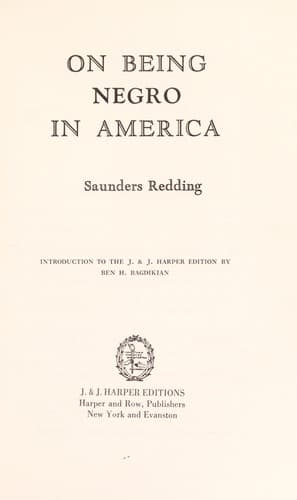
On Being Negro in AmericaRedding, J. Saunders (Jay Saunders)
General
On Being Negro in America
Redding, J. Saunders (Jay Saunders)
African Americans -- Race identity; Redding, J. Saunders (Jay Saunders), 1906-1988; United States -- Race relations
“But if she were outside it, I was outside it too, and I kept thinking
that Honey had some ulterior motive and that she was trying to realize
it at too high a price. I knew that she wanted me to have sex relations
with her and I knew also that I would not, could not, dared not. I do
not think she tempted me at all, really; she just frightened me. I did
not see how anyone could go to such a length to obtain a result that in
the long run could have almost no importance. Certainly I cannot think
myself _that_ important to the Communists. And suppose this were not her
reason? Then what? Just sex. I cannot trust a white woman that way. No
matter how willingly a white woman gives herself to a colored man, if
she is found out, she will yell rape. Last night I pictured newspaper
headlines such as I have seen many times and I thought of them referring
to me: BLACK BRUTE. I did the right thing last night, though maybe I did
it for all the wrong reasons.”
I fled. Though I knew I had done the right thing, I was ashamed to see
Honey and Philip again, for I convinced myself that I had been naïf and
cowardly. I did not go back to the little restaurant at the bottom of
the hill. Once I had a note from Philip, and once he—or someone very
like him—inquired of me from my landlady, but I did not see him, nor
Honey, nor any of the people I used to see in the cell. I am certain
that Honey, laughing with strident insolence, spoke of me as one of
Philip’s “untouchable unteachables,” and pretty quickly forgot me.
9
But I did not forget Communism, then or later. In New York the next
year, 1933, the Party was quite fashionable among my acquaintances, some
of whom took it seriously. One could be sure that among the guests at
Harlem’s middle and upper-class social gatherings would be white people
and that these were admitted Communists or fellow travelers at least.
Some of them were said to be well known in _avant-garde_ and esoteric
circles and in the theater but I had never heard of most of them, and I
am inclined to think that the reputations they were given in Harlem were
a kind of defense in depth against the allegation that the only whites
Negroes could mingle with socially were peripheral people, nobodies,
tramps. The white people I met at such parties seemed average
intellectual types. I was struck by the fact that they did not talk
Communism, but gave the impression of living on a higher and freer level
than American democracy afforded. The atmosphere they created was easy
and sophisticated, with a high sexual content of which, it was said,
nearly everyone took advantage. No one bothered to whisper the stories
of liaisons between white women and Negro men and Negro women and white
men. They were accepted without shock, and the actors in these little
dramas seemed to play their roles with a lack of embarrassment and even
a natural grace that fascinated me.
Public-domain text, read in full here on John Shaqi.
Reviews
Reviews
No reviews yet
Be the first to share your thoughts on this work.
Join the Discussion
Join the discussion
Sign in to leave a comment or review.
Sign InorCreate an account