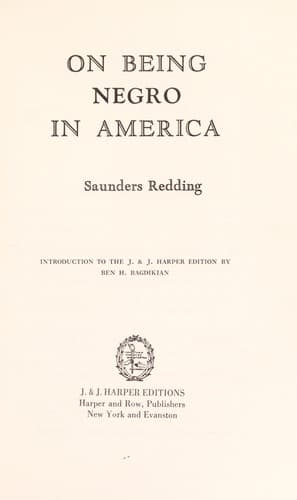
On Being Negro in AmericaRedding, J. Saunders (Jay Saunders)
General
On Being Negro in America
Redding, J. Saunders (Jay Saunders)
African Americans -- Race identity; Redding, J. Saunders (Jay Saunders), 1906-1988; United States -- Race relations
I do not think any of the Communists I met in these circumstances were
seriously political-minded. Certainly they were not Party workers. They
did not make speeches from flag-draped stepladders wedged against
curbings, as so many Communists were doing daily in front of the Home
Relief stations scattered over the city. They did not rustle up
meetings, nor belong to instructional cells, nor try to indoctrinate
anyone. They were not of the “soiled shirt, sinkers and coffee brigade.”
My Negro acquaintances would not have had them in their homes if they
had been. Communism was merely the rose under which they pursued more
pleasurable activities.
There were a good many hastily printed Communist leaflets being passed
out in those days. I seemed to get them all; I also read them. They were
slanted for the middle-class Negro—the professional, the intellectual,
the student. With only half an eye one could see that the Party was
conducting a campaign to recruit a potential, educated Negro leadership.
The labor masses had been a disappointment to the Communists who,
anyway, employed the wrong methods to enlist them. Negro labor was far
from ready for the proletarian revolution. It was not class struggle but
race struggle that interested them. What the Negro labor masses wanted
was to be treated as a special case first. They wanted job security.
They wanted to be brought up to the level of white workers before they
could march in the ranks with them toward the bigger Communist goal.
Equality first, and then integration. Besides, Negro labor had the same
suspicion of Communism that it had of socialism and trade-unionism—a
suspicion of being used rather than helped, and used for the
establishment of an order of things that was not quite clear.
So the new recruitment was to be among the class of which I was an
inconsequential representative. The Communists were determined not to
make the same mistake twice. _Equality, Land and Freedom: A Program for
Negro Liberation_, issued by the League of Struggle for Negro Rights in
1933, put it this way: “The task that confronts the ... Party in
organizing the Negro workers and rallying them for the daily class
struggle ... side by side with the white workers is no light one.... The
Negro evinces no militant opposition towards Communism, but he wants to
know how it can improve his social status, what bearing does it have on
the common practice of lynching, political disfranchisement,
segregation, industrial discrimination.... The Negro is revolutionary
enough in a racial sense....” In short, he is race-conscious, and this
was enough to concentrate on. In the late 1920’s and the early 1930’s,
the Communists got some good advice from somewhere. They also took
advantage of two circumstances.
Public-domain text, read in full here on John Shaqi.
Reviews
Reviews
No reviews yet
Be the first to share your thoughts on this work.
Join the Discussion
Join the discussion
Sign in to leave a comment or review.
Sign InorCreate an account