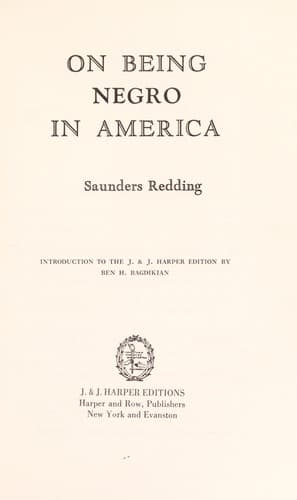
On Being Negro in AmericaRedding, J. Saunders (Jay Saunders)
General
On Being Negro in America
Redding, J. Saunders (Jay Saunders)
African Americans -- Race identity; Redding, J. Saunders (Jay Saunders), 1906-1988; United States -- Race relations
The Angelo Herndon case was still bubbling and boiling and the
Scottsboro case was just reaching another of its vociferous climaxes in
1933. The International Labor Defense was formed in those days, and I
met William L. Patterson, its secretary. Next to James D. Ford, the
Communist Party’s Vice-Presidential nominee in 1932, Patterson held the
highest rank of any Negro in the Party. But I was not impressed by him.
He seemed of small intellectual caliber, though very ambitious and bold.
I was more impressed by a well-known and engaging Negro journalist. He
had just returned from Russia (and, I suppose, a period of
indoctrination) when I met him backstage at the Fourteenth Street
Theatre, where _Stevedore_ was playing. I can remember his saying to me,
“We Negro writers have a great opportunity and an inflexible duty to
promote the revolution that will extirpate caste, class and race.” How
flattering! “We Negro writers—” to lump me in with Langston Hughes,
Claude McKay, Jean Toomer, Rudolph Fisher, Countee Cullen and himself,
all of them talented, all of them well known. He could not possibly have
heard of me—I had written and published professionally only one story at
that time. But the Negro art and literary “renaissance” had not waned
enough for those close to it to see that it was fading, and now and
then, a completely unknown student, I basked in that artificial light
like a homeless beggar keeping himself warm over a sidewalk grating.
But Communism gave off a light of a different quality. It had no comfort
in it. As harsh and as revealing as the light in a surgical operating
room, it cast no cozy shadow into which one could slip for those moments
of quiet reflection which seemed as necessary to me as food and drink.
Communism did not allow for the play of individual thought and
initiative. It had no warmth in it. Or perhaps it is untrue to say this,
since intense heat and intense cold produce the same primary reaction—a
shriveling up, a drying out, until the living thing loses its own
identity and becomes one with the heat or the cold. I saw something of
this reaction in New York and I was appalled by it. Or perhaps this too
is untrue. Perhaps what appalled me was the realization that there were
people who felt themselves so helplessly cast out of American society
and democratic reckoning that they could suck with voracious hunger at
the cold breast of Communism. One of the things I could not understand
was the unquestioning submission to control.
Public-domain text, read in full here on John Shaqi.
Reviews
Reviews
No reviews yet
Be the first to share your thoughts on this work.
Join the Discussion
Join the discussion
Sign in to leave a comment or review.
Sign InorCreate an account