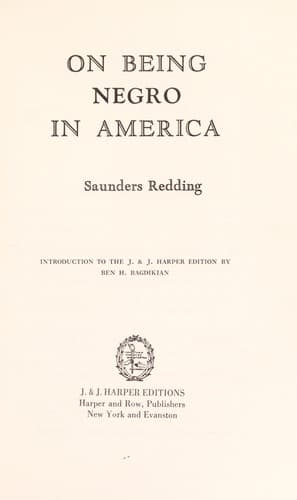
On Being Negro in AmericaRedding, J. Saunders (Jay Saunders)
General
On Being Negro in America
Redding, J. Saunders (Jay Saunders)
African Americans -- Race identity; Redding, J. Saunders (Jay Saunders), 1906-1988; United States -- Race relations
Add to this one other matter, and the whole story (though
oversimplified) of that failure is told. Add patriotism. In some
sophisticated Negro circles it is a matter for amused laughter that no
Negro has ever been a traitor to the United States. But the laughter
does not abrogate the fact. More perhaps than other American minorities,
Negroes have had inducements to treachery. Clark expressed it: “What has
this country ever done for me?” And of course Negroes before and since
have asked the same question. It is purely rhetorical. Clark did not
realize it, but America, its ideals, its direction, its basic spirit
(for we must again deal with abstractions) had given him a belief in the
individual worth and dignity of himself as a man. DuBois, I think, was
right when, back in his young, good days, he said, “First, this is our
country: we have worked for it, we have suffered for it, we have fought
for it ... we have reached in this land our highest modern development
and nothing, humanly speaking, can prevent us from eventually reaching
here the full stature of our manhood.... Our wrongs are still wrong
[but] we will not bargain with our loyalty.”
I am just cynical enough to add a sour note. This loyalty comes in part
from a fear of expulsion. It is a historic fear, stemming back to the
colonization movement in the seventeenth century. Recently Negroes have
seen another minority in other countries expelled, and they know it can
be done. But American Negroes have no Palestine.
I will not say that Negroes saw democracy as the highest, final product
of man’s political development, nor that they saw enough differences
between Communism and democracy to reassure them of the worth of the
latter. They did not come to that stage of intellection—and neither did
I until much later. I do not think that even the Negro Communists, so
recently in the news, with all their reputation for mental acumen, have
thought much about the real differences. For actually, of course, the
Communist doctrine, like the dogma of the most fundamental religious
sect, does not encourage thought. If it did, there probably would be
less than a villageful of Communists in the whole Western world, for it
would be seen that Communism is a falling away from the idea that the
Western world has lived by since the Middle Ages—the idea that _man_ is
the end of all human endeavor, and that mere “survival and security” are
not enough for man. But this distinction is only gross enough to explain
why Communism is the ideology of crisis; why it must seize its chance to
win men’s minds when their highest hope is only to stave off death. No,
even the intellectuals seem not to have seen this; and the other
distinctions are subtler, finer. But they are also fundamental.
Public-domain text, read in full here on John Shaqi.
Reviews
Reviews
No reviews yet
Be the first to share your thoughts on this work.
Join the Discussion
Join the discussion
Sign in to leave a comment or review.
Sign InorCreate an account