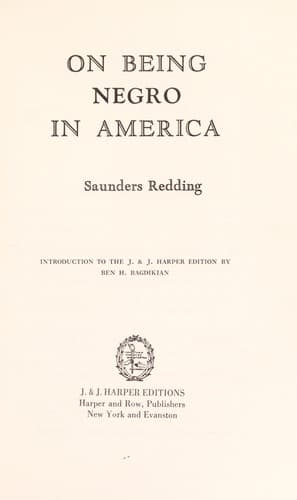
On Being Negro in AmericaRedding, J. Saunders (Jay Saunders)
General
On Being Negro in America
Redding, J. Saunders (Jay Saunders)
African Americans -- Race identity; Redding, J. Saunders (Jay Saunders), 1906-1988; United States -- Race relations
Finally I turned irresolutely and went into the corridor. There was the
entrance door and near it the telephone. I could have gone out and a few
steps would have brought me to the yard where the woman lay and I could
have tried to rouse someone or myself taken her into the house. I went
to the telephone and called the police.
“There’s a drunken woman lying in the back yard of a house on Eighth
Street, seven-hundred block,” I said.
“You say drunk? In her own yard? Then leave her lay.”
“But there doesn’t seem to be anyone there, and she may not be drunk.”
“You said she was drunk,” the voice said. “Now what’s the story?” There
was a pause. “And who’re you anyway?”
“She could freeze to death,” I said, and hung up. Thus I washed my hands
of it.
The woman was still lying there and the dog sat quivering and whining
near her when a lone policeman arrived almost an hour later. The next
morning I read on a back page of the local paper that the woman, aged
twenty-six, had died of exposure following an epileptic seizure suffered
while alone.
One can wash his hands, but the smudges and scars on the psyche are
different.
I offer no excuses for my part in this wretched episode. Excuses are
unavailing. The experiences of my Negroness, in a section where such
experiences have their utmost meaning in fear and degradation, canceled
out humaneness. How many times have I heard Negroes mutter, when witness
to some misfortune befallen a white person, “What the hell! He’s white,
isn’t he?” What the exact psychological mechanism of this is, I cannot
say, but certainly the frustration of human sympathy and kindness is a
symptom of a dangerous trauma. Never having been white, I do not know
whether Southern white people feel a similar reaction to Negroes, but,
considering their acts and their words, it can hardly be judged
otherwise. Actions speak for themselves; printed words not always.
For there is this about books on the “race question” (how weary one
grows of the phrase!) by Southern whites: they have no detachment. They
may seem to have. Within what has always seemed to me a questionable
frame of reference, there may be brilliant exposition, analysis,
interpretation, and even history. They may roar, as do the writings of
David L. Cohn; they may purr lyrically and graciously in the manner of
Archibald Rutledge and the late William Alexander Percy; they may
remonstrate and apologize with unobtrusive erudition, as Virginius
Dabney’s and Hodding Carter’s editorials do; or they may bristle with
the flinty phraseology of Howard Odum’s scholarship—but nearly all of
them elaborate an argument that is certainly not derived from
self-knowledge and that cannot be effective as an instrument of
self-control.
Public-domain text, read in full here on John Shaqi.
Reviews
Reviews
No reviews yet
Be the first to share your thoughts on this work.
Join the Discussion
Join the discussion
Sign in to leave a comment or review.
Sign InorCreate an account