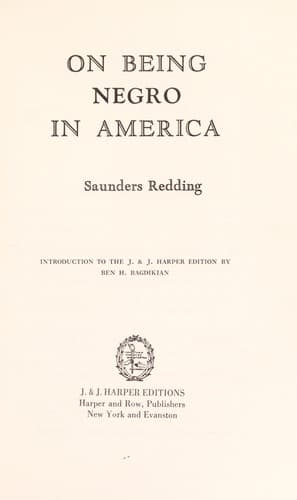
On Being Negro in AmericaRedding, J. Saunders (Jay Saunders)
General
On Being Negro in America
Redding, J. Saunders (Jay Saunders)
African Americans -- Race identity; Redding, J. Saunders (Jay Saunders), 1906-1988; United States -- Race relations
I had written a book called _No Day of Triumph_, and the Communists saw
advance copies of it. They liked it, though I am still puzzled why.
Perhaps it was because I did not actually condemn Communism, but, as a
matter of fact, expressed sympathy for one Mike Chowan who had long been
a Communist and who had fought with the Lincoln Battalion in Spain.
Whatever the reason, _New Masses_ first published an excerpt from my
book, without, as I remember, getting either my permission or that of
the publisher. Soon after the _New Masses_ excerpt appeared and several
weeks before publication, I began to get letters from Communists all
over the country. Some of these came from bookstore managers who told me
that they were going to push the book and who invited me to teas and to
hold autograph parties. I accepted only one of these invitations—to
speak to a group in Washington, where I had to go on other business
anyway. Later I was asked to appear on a radio program with Ella Winters
in Philadelphia, but a previous commitment interfered.
A little while after publication, I went to New York to attend a dinner
party for Carl Van Vechten. When that was over sometime after midnight,
without quite realizing what we were in for, my wife and I accepted an
invitation to another gathering, and found ourselves in an apartment on
West 56th Street, surrounded by a motley crowd who told me that they
were going to make _No Day of Triumph_ a best seller. They were going to
put me, as a writer, they said, in the same income class with Howard
Fast and Richard Wright, who, they claimed, but for them, would not have
been where they were. Toward dawn, what seemed to be a committee of
three cornered me in the kitchenette and asked me whether I would sign a
card. I said I would have to think about it. What I have written above
is what I thought.
11
So far as I know, no one from the outside has ever tried to infect the
Negro group with fascism. There have been some inside the group, but,
excepting Marcus Garvey, I do not think they were consciously fascist.
Negro colleges have tended to breed fascism—I would say a mild form of
it, except that fascism is organically hysterical and there is no mild
form of it—and I have met Negro college presidents whose notions are
provocative of suspicious wonder and who, by the way they run “their”
institutions, seem to be convinced that the methods of democracy are
weak and decadent. Themselves, generally, victims of a tyranny imposed
from without, they are tyrants within the academic group, and, if given
a chance, outside it too. They play the strong man and the dictator
role. They think that people and things should be “lined up” by the
superior intellects with which they feel their positions endow them.
They have a vast contempt for faculty members whom they regard as justly
underprivileged employees perhaps of somewhat more value than janitors
but of considerably less value than football coaches.
Public-domain text, read in full here on John Shaqi.
Reviews
Reviews
No reviews yet
Be the first to share your thoughts on this work.
Join the Discussion
Join the discussion
Sign in to leave a comment or review.
Sign InorCreate an account