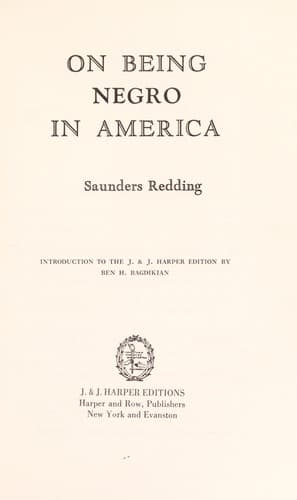
On Being Negro in AmericaRedding, J. Saunders (Jay Saunders)
General
On Being Negro in America
Redding, J. Saunders (Jay Saunders)
African Americans -- Race identity; Redding, J. Saunders (Jay Saunders), 1906-1988; United States -- Race relations
More dangerously, this presidential contempt engulfs students, who grow
into maturity with personalities habituated to submission and who are
likely to believe in the infallibility of the dictatorship principle. In
general, Negro-educated Negroes have never learned to live with Freedom
and this is why they are almost totally missing from the ranks of those
who apply the privileges and the tools of democracy to the construction
of Freedom’s spacious house. Where they have taken over as leaders of
Negro communities there rises a nauseating reek of devious and oily
obsequiousness. It is a kind of fascism in reverse.
A group of Negro parents in a Virginia city wished to equalize the
facilities of the Negro school with those of white schools. One of the
things that the colored school lacked was a cafeteria. This was
particularly noticeable because the city school board had just added
such a convenience (at a cost of $20,000) to the only white school
without it. The Negro parents went to the principal of their own school.
As an ambitious and hard-working educator, less complacent and
timeserving than most of his type, he had ideas, and the chief one was
that the parents’ group solicit funds (he thought $2,500 would do it!)
in Negro homes, churches, and other racial institutions. By a show of
initiative and energy, he thought, it might be brought home to the white
people that Negro citizens were worthy of consideration.
Naturally among those to whom the project was first presented was the
Negro acknowledged as the colored community’s leader—a lawyer, graduate
of a Negro college and a white law school. The esteem he commanded among
his own people and the attention he could get from the whites were very
real.
A friend of mine happened to be in the lawyer’s office when the
committee of parents went there. Whether out of boorishness, as my
friend thinks, or because of the very human desire to prove his
influence, or because he clearly saw his duty as a leader, the lawyer
took over completely. “We’ll get in touch with some real money,” he
said. “No point in piddling around with the colored folks’ two cents’
worth.” Then, picking up the telephone, he called several of his white
“friends”—a peanut-produce manufacturer (he carefully identified them
between calls), a banker and an insurance broker, among others—and
explained to them the Negro parents’ project for the school. In ten
minutes of “the most consummate fawning,” my friend said afterward, the
lawyer had solicited pledges of more than a thousand dollars. He typed
out an identifying statement for the parents and sent them off to
collect from his white friends.
Public-domain text, read in full here on John Shaqi.
Reviews
Reviews
No reviews yet
Be the first to share your thoughts on this work.
Join the Discussion
Join the discussion
Sign in to leave a comment or review.
Sign InorCreate an account