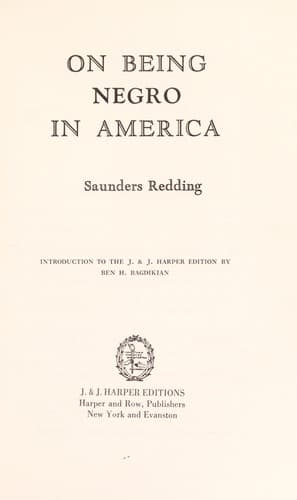
On Being Negro in AmericaRedding, J. Saunders (Jay Saunders)
General
On Being Negro in America
Redding, J. Saunders (Jay Saunders)
African Americans -- Race identity; Redding, J. Saunders (Jay Saunders), 1906-1988; United States -- Race relations
What happened to my older son (and also to my younger son just recently,
though not in circumstances so distressing nor in details so graphic)
was that while he was playing the game with all the exuberance of an
eight-year-old, somebody “complicated up” the rules. I remember
distinctly how it happened.
For several weeks while my wife was with child it was my unaccustomed
duty to “make the marketing,” as it is so quaintly put in the upper
South. Our market was a co-op on the highway just outside town, in the
heart of one of those neat and monotonous residential communities that
seemed to spring up everywhere in the 1940’s. My wife loved the place.
It was convenient; its stock was excellent; and its prices generally
somewhat lower than in the chain groceries. Besides, it had a Negro (a
colleague and friend) on its board of directors, and, as a second novel
attraction, it employed several Negroes—at least one as clerk and
another as butcher. The co-op’s atmosphere, unlike that of the chain’s,
was friendly, warm, leisurely. My wife supposed it was because of the
neighborhood—a better-than-average middle-class neighborhood, segregated
of course, of aircraft designers, engineers and other technological
experts and a scattering of armed-service personnel (no one lower than a
lieutenant in the Navy or a captain in the Army, it seemed) from the
various military installations close by. As one of the charter
stockholders, I was determined to love the place too.
Friday was market day. Until her condition prevented her going, my
wife’s eager companion on these expeditions was our son. Sometime in the
spring he had struck up a friendship at the co-op and he anticipated its
weekly renewal with pleasurable excitement. The first time I took him
there I saw the revival of the fraternity with quickened heart. My son
burst through the door ahead of me, stopped, looked down the first aisle
(fresh fruits and vegetables), ran to the second and looked, and then
suddenly let out an Indian whoop—“Reggie!”—and got one for an
answer—“Conway!” And then I saw a handsome dark-haired, dark-eyed boy of
about Conway’s age break from the side of a young Negro girl and come
bursting up the aisle between the high-stacked shelves of brightly
packaged foods toward my son. They stood looking at each other for a
moment, then they came together, each with an arm around the shoulder of
the other, and exploded off to play outside among the cars until market
was made. I looked at the uniformed Negro girl and she smiled and I
smiled, and that was that.
It was that way for four or five weeks—Conway and Reggie met each other
with what seemed the force of projectiles and went skyrocketing off.
Leaving the market, I would find them outside, hot and happy playing at
some impossible game.
Public-domain text, read in full here on John Shaqi.
Reviews
Reviews
No reviews yet
Be the first to share your thoughts on this work.
Join the Discussion
Join the discussion
Sign in to leave a comment or review.
Sign InorCreate an account