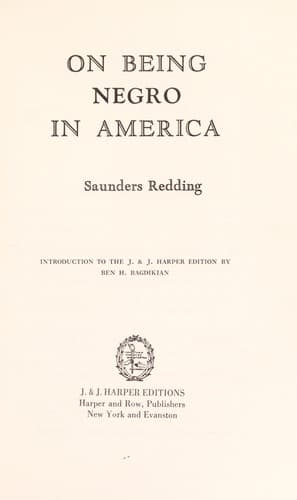
On Being Negro in AmericaRedding, J. Saunders (Jay Saunders)
General
On Being Negro in America
Redding, J. Saunders (Jay Saunders)
African Americans -- Race identity; Redding, J. Saunders (Jay Saunders), 1906-1988; United States -- Race relations
Then one Friday, Reggie (we never learned his last name) was not there
with the Negro maid. His guardian this time was a man—a tall, handsome
person, about forty, I judged, who in spite of the Phi Beta Kappa key
slung across his flat stomach, looked outdoorsy and virile. The boys
came together as usual and went outside as usual, but the man’s
marketing must have been nearly done, for before I could finish picking
out the heaviest, juiciest oranges, Conway was back with me again.
“Where’s Reggie?” I asked him. “He had to go,” he said. “His daddy was
in a hurry.” But already he was looking forward to the next week.
The uniformed maid was with Reggie again the next week, but this time
when Conway let out his customary whoop, there was no vocal answer.
Reggie turned, it seemed to me with momentary eagerness, but there was
no yell and rush. He approached very slowly. He was smiling weakly, but
that smile died as he came. Perhaps sensing that something was wrong,
Conway himself now hesitated. “What’s the matter?” he asked Reggie.
“Come on, man, let’s go. Don’t you want to play?”
“I can’t play with you,” Reggie said.
“What’s the matter, are you sick?” Conway wanted to know.
“I just can’t play with you any more,” Reggie said.
Conway moved a fraction closer to me, clutched the handle of the food
cart I was pushing. The maid stood at some distance, pretending not to
watch. The pleasant-voiced, pleasant-faced shoppers of the neighborhood
flowed around us. Other children, younger, skittered and yelled up and
down the aisles. The compacted odors of fresh pastry, of ground coffee,
of fruits and vegetables, and the colors of all these were as ever. But
a chill was beginning to form around my heart. Before Conway asked the
next question, I knew the answer that was coming. I did not know the
words of it, but I knew the feel—the iron that he would not be prepared
for; the corrosive rust that it would make in his blood and that, unless
I was skillful—as my father was not—I could never draw off. At that
moment—no, before the moment of the answer I wanted to pick Conway up
and hold him hard against me and ward off the demoralizing blow that
might be struck for a lifetime. But I could not forfend it even by
grasping my son by the hand and walking off in another direction. I was
transfixed.
“Why?”
Reggie scowled then, a grimace that was not really ugly yet, because it
was associated only with words and not with feeling. That would come
later, and the word would be made flesh, and the flesh would be his
forever. Now the scowl was only imitation.
“Because you’re a nigger, that’s why,” Reggie said.
Conway looked at me wonderingly, not feeling hurt, as they say a man
knowing himself shot but still without pain will look with surprise.
“I’m better than you,” Reggie said, “’cause my father said so.”
“You are not,” Conway said, but I thought he shrank a little against me.
“No, son, he isn’t,” I said.
Public-domain text, read in full here on John Shaqi.
Reviews
Reviews
No reviews yet
Be the first to share your thoughts on this work.
Join the Discussion
Join the discussion
Sign in to leave a comment or review.
Sign InorCreate an account