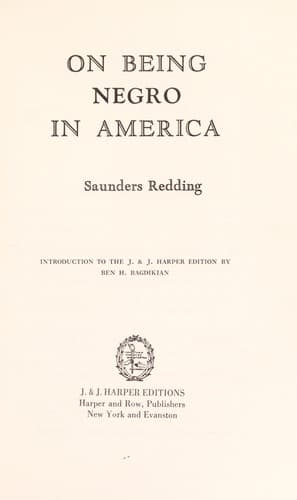
On Being Negro in AmericaRedding, J. Saunders (Jay Saunders)
General
On Being Negro in America
Redding, J. Saunders (Jay Saunders)
African Americans -- Race identity; Redding, J. Saunders (Jay Saunders), 1906-1988; United States -- Race relations
This was the deeper infection, and I did not know how to deal with it.
Words were poultices to seal the infection in. I could recall them from
my own childhood in answer to a “why?” For children are not born with
answers. Words spoken by my parents, my teachers, my friends. Words
could seal in the infection and seal in also the self that might never
break through again except with extreme luck. But I had no choice save
to use them. I told him about prejudice. No one has ever made the
anatomy of prejudice simple enough for children.
“And the reason you don’t go to Reggie’s school,” I remember saying, “is
because there are people like Reggie’s father.”
“It’s all complicated up,” Conway answered.
It was a relief to laugh at his child’s expression, but I noticed he was
not laughing, and at home some minutes later, when I had finished
storing the groceries in the pantry, I found him pressed against his
mother’s rounded bosom crying without restraint. But even that did not
end it. “He cried it all out,” his mother said. She was wrong.
Seven years afterward, in the late spring of 1950, we had a letter from
the headmaster of Conway’s New England preparatory school: “We have been
unable to reach him.... He seems to prefer to be alone and will not
participate even in those activities for which he has undoubted talents.
Naturally this attitude has given us serious concern, for an important
part of our educational program is training in citizenship and
co-operative living....”
Perhaps there is only a slight connection, but I would be hard to
convince.
13
I am well aware that there is supposed to be something reprehensible in
advocating marriage between races—enough, were I a faculty member in a
public-supported college in the South, to bring about my dismissal for
advocacy of it. In some metaphysical corner of the white man’s mind
intermarriage is identified with immorality, biological peculiarity and
perversion. This identification is partly a matter of conscience and, as
Gunnar Myrdal exhaustively explains, partly a matter of jealousy. The
unrestricted use of the Negro woman as sex mate and mammy during slavery
did a strange thing to the white man’s mind. It filled it with anxiety,
guilt, and a grotesque exaggeration of the Negro male’s sexual
equipment—an equipment from which the white male has felt compelled to
protect white womanhood ever since. In Myrdal’s words, “The necessity to
‘protect’ the white female against this fancied prowess of the male
Negro [is] a fixed constellation in the ethos” of America.
Public-domain text, read in full here on John Shaqi.
Reviews
Reviews
No reviews yet
Be the first to share your thoughts on this work.
Join the Discussion
Join the discussion
Sign in to leave a comment or review.
Sign InorCreate an account