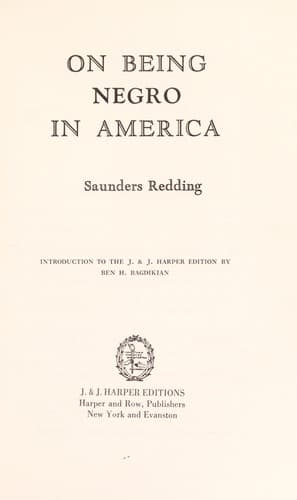
On Being Negro in AmericaRedding, J. Saunders (Jay Saunders)
General
On Being Negro in America
Redding, J. Saunders (Jay Saunders)
African Americans -- Race identity; Redding, J. Saunders (Jay Saunders), 1906-1988; United States -- Race relations
“I am so, too,” Reggie said, looking at both of us. Words were beginning
to arouse emotion and link with emotion. The sneer was no longer
imitation. He stood bearing his weight on his left foot, his hands in
the pockets of his khaki shorts, the whiteness of him showing in a
streak just below the hairline, the rest of him—bare trunk, bare
legs—tanned almost to the color of my son.
“No, son,” I said, as much to the one as to the other. I think I felt
sorry for Reggie too. I do now at any rate, thinking back.
“You are not,” Conway said, and straightened. “My daddy says you
aren’t.”
“You don’t go to my school, you don’t go to my church, you don’t go to
the movies I go to. I bet you never even seen Tim Holt,” he put in
parenthetically, “and that’s because you’re not good enough. Yah-yah!”
Reggie said. “Niggers work for us, niggers work for us, you’re a nigger
and Trixie’s a nigger and Trixie works for us.” It was a shrilling
singsong. “Yah-yah nigger nigger, go peddle your papers, nigger!” With
this he ran off, back, I suppose, to Trixie, who worked for him because
she was a nigger.
Conway did not cry, but in his eyes was the look of a wound, and I knew
how it could grow, become infected and pump its poison to every tissue,
to every brain cell. He stayed close to me while I made market. On the
way home, he said savagely, “I hate this car!”
It did not seem like any kind of entree to what I knew I must talk
about, and the sooner the better. When what happened to him happens it
makes a nasty wound which demands immediate attention. You want a knife
to do the job quickly, deftly, cleanly, but the only instruments in the
surgery kit are words.
So when I wanted to know what was wrong with the car and why he hated
it, and he said, “Why can’t we have a good car, a new one with a radio,
and a bigger one—like Reggie’s?” I tried to explain to him that it was
wartime, that cars were scarce and prices high, and that in order to get
a new car you had to do something a little underhanded, something that
was not much different from stealing or cheating.
“Did Reggie’s father steal?”
“I wouldn’t say that,” I said, “but I wouldn’t put it past him. He’s not
a good man.”
“How do you know? You don’t know him, do you?”
“No,” I said, “but I don’t have to know him to know he’s not a good
man.” I put it as simply as I could. I told him that parents are
frequently reflected in their children. I made him laugh a little by
reminding him of the time, when he was six, he had acutely embarrassed
his mother and me by telling one of our friends, “I think you have
store-bought teeth,” which was exactly what he had heard me say about
the friend.
“Those things Reggie said today, his father said to him. That’s how I
know Reggie’s father is not a good man.”
“He wasn’t telling the truth, was he?”
“No,” I said, shaking my head.
“I mean about him being better?”
“No,” I answered.
“Then why can’t I go to his school and to his movies?”
Public-domain text, read in full here on John Shaqi.
Reviews
Reviews
No reviews yet
Be the first to share your thoughts on this work.
Join the Discussion
Join the discussion
Sign in to leave a comment or review.
Sign InorCreate an account