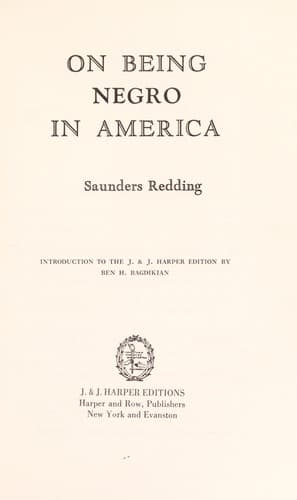
On Being Negro in AmericaRedding, J. Saunders (Jay Saunders)
General
On Being Negro in America
Redding, J. Saunders (Jay Saunders)
African Americans -- Race identity; Redding, J. Saunders (Jay Saunders), 1906-1988; United States -- Race relations
As an ideal, of course, I am all for the deletion of racial designations
in newspaper stories and the like. But the ideal is nowhere near
attainment. It seems that it is still a general practice in newsrooms in
a large part of the country to specify race when Negroes are involved in
crime, and it is still usual to omit, except from feature stories and
special articles, racial designation in news copy that would reflect
credit on the colored people. When Ralph Bunche stepped in as mediator
of the Jewish-Arab dispute, the fact that he was an American Negro first
broke in the foreign press. In spite of hundreds of front-page news
stories from competent war correspondents, it is even now not generally
known that the 24th Infantry, which fought so hard and bought with its
life (it was almost totally destroyed) the time General MacArthur needed
in the early fighting in Korea, was a Negro outfit in the segregated
United States Army.
Personally, as matters stand, I would settle for something less than the
ideal. Seldom does one see the minority-group designations “Italian,”
“Greek,” “Jewish,” “Irish,” and the like attached to crime stories
involving persons of these groups. But neither, it is replied, do you
see them attached to other stories. True, and this is all very well. It
is a matter of nomenclature. Negro names being what they generally
are—as indigenous to America as “hot dog,” or as unmistakably
Anglo-Saxon-derived as “Gudger”—Ralph Bunche and Charles Drew, William
Hastie and George Dows Cannon might belong to any Anglo-Saxon,
Protestant or Catholic. But no one of reading intelligence would mistake
Bernard Baruch or Sholem Asch as of other than Jewish heritage, or
Fiorello LaGuardia and Vincent Impellitteri as of other than Italian
ancestry, or George Skouras as of other than Greek, or Roosevelt and
Vanderbilt as other than Dutch, or William Cardinal O’Connell as other
than Irish. We make these associations automatically, and there passes
into the communal intelligence some sense of the contributions these
groups make to American life. On the other hand, diffused throughout our
national life and thought is the fallacy that the Negro has contributed
nothing substantial.
Public-domain text, read in full here on John Shaqi.
Reviews
Reviews
No reviews yet
Be the first to share your thoughts on this work.
Join the Discussion
Join the discussion
Sign in to leave a comment or review.
Sign InorCreate an account