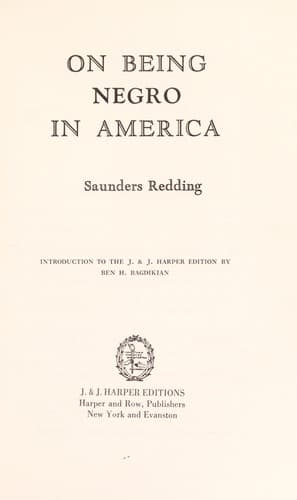
On Being Negro in AmericaRedding, J. Saunders (Jay Saunders)
General
On Being Negro in America
Redding, J. Saunders (Jay Saunders)
African Americans -- Race identity; Redding, J. Saunders (Jay Saunders), 1906-1988; United States -- Race relations
Not to know the Negro on the group and historical level is to rob him of
his pride and of his rightful share in the American heritage. He cannot
claim what is his, except in an intorted and psychologically unhealthy
way. The Negro on the lower levels saves himself from complete madness
by following a pattern of neurotic expression that is patent in his
lazy-lipped and mumbling speech, in his gay-bird dress, and in his
prowlike walk. The Negro on the upper level turns back upon himself with
a voracity of egocentrism that bewilders the casual observer. “What a
self-conscious people your Negroes are!” a recent French visitor
exclaimed. He was right. The Negro lives constantly on two planes of
awareness. Watching the telecast of a boxing match between Ezzard
Charles, the Negro who happened to be heavyweight champion, and a white
challenger, a friend of mine said, “I don’t like Charles as a person
[one level] but I’ve got to root for him to beat this white boy—and good
[second level].”
One’s heart is sickened at the realization of the primal energy that
goes undeflected and unrefined into the sheer business of living as a
Negro in the United States—in any one of the United States. Negroness is
a kind of superconsciousness that directs thinking, that dictates
action, and that perverts the expression of instinctual drives which are
salutary and humanitarian—the civic drive, for instance, so that in
general Negroes are cynically indifferent to politics; the societal
drive, so that ordinarily the Negro’s concern is only with himself as an
individual; and even the sex and love drive, so that many Negroes suffer
sexual maladjustments and many a Negro couple refuse to bear children
who will “inevitably grow up under a burden of obloquy and shame that
would daunt and degrade a race of angels.” It is impossible to believe
with Lillian Smith that the psychological damage caused by the race
situation in America is greater to whites than to Negroes. “Every one of
us knows,” an internationally known Negro said recently, “that there is
no ‘normal’ American Negro.” Public asylums for the mentally deranged
offer a telling statistic. Though Negroes are something less than ten
per cent of the country’s population, they are eleven per cent of the
total population of public institutions for the insane.
Public-domain text, read in full here on John Shaqi.
Reviews
Reviews
No reviews yet
Be the first to share your thoughts on this work.
Join the Discussion
Join the discussion
Sign in to leave a comment or review.
Sign InorCreate an account