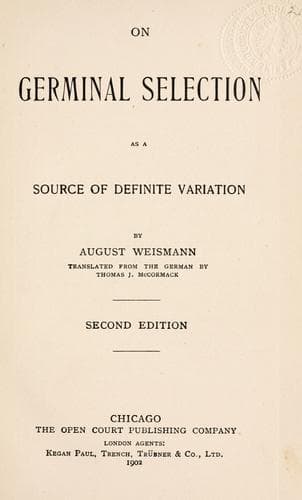
On Germinal Selection as a Source of Definite VariationWeismann, August
Science
On Germinal Selection as a Source of Definite Variation
Weismann, August
Variation (Biology)
The cogency of the facts is absolutely overpowering when we consider that
practically no modification occurs _alone_, that every primary modification
brings in its train secondary ones, and that these induce forced
modifications in many parts of the body, frequently of the most
diversified, or even self-contradictory, forms. Recently Herbert Spencer
has drawn {29} fresh attention to these secondary modifications, which must
always occur in harmony with the primary one, and has, as he thinks,
advanced in this set of facts, a convincing disproof of the contention that
such coadaptive modifications of numerous cofunctioning parts can rest on
natural selection. Now, although I deem his conclusion precipitate, yet the
very fact of a simultaneous, functionally concordant, yet essentially
diversified modification of numerous parts, points conclusively to the
circumstance that _something is still wanting to the selection of Darwin
and Wallace, which it is obligatory on us to discover, if we possibly can_,
and without which selection as yet offers no complete explanation of the
phyletic processes of transformation. There is a hidden secret to be
unriddled here before we can obtain a satisfactory insight into the
phenomena in question. _We must seek to discover why it happens that the
useful variations are always present._
Herbert Spencer appealed to Lamarck's principle for the explanation of
coadaptation, and it is certain that functional adaptation is operative
during the individual life, and that it compensates in a certain measure
the inequalities of the inherited constitutions. I shall not repeat what I
have said before on this subject, nor maintain, in refutation of Spencer's
contention, that functional adaptation is itself nothing more than the
efflux of _intra-biontic_ selective processes, as Spencer himself once
suggested in a prophetic moment, but which it was left for Wilhelm Roux to
introduce into science as "the struggle of the parts" of organisms.[10] I
shall only remark that if functional adaptations were themselves
inheritable, this would still be insufficient {30} for the explanation of
coadaptation, for the reason that precisely similar coadaptive
modifications occur in _purely passively_ functioning parts, in which,
consequently, modification _by_ function is excluded. This is the case with
the skeletal parts of Articulata; e. g., it is true of their articular
surfaces with their complex adaptations to the most varied forms of
locomotion. In all these cases the ready-made, hard, unalterable, chitinous
part is _first_ set into activity; consequently its adaptation to the
function must have been _previously_ effected, independently of that
function. These joints, and divers other parts, accordingly, have been
developed in the precisest manner for the function, and the latter could
have had no direct share in their formation. When we consider, now, that it
is impossible that every one of the numerous surfaces, ridges, furrows, and
Public-domain text, read in full here on John Shaqi.
Reviews
Reviews
No reviews yet
Be the first to share your thoughts on this work.
Join the Discussion
Join the discussion
Sign in to leave a comment or review.
Sign InorCreate an account