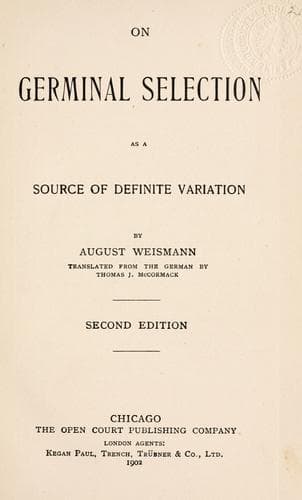
On Germinal Selection as a Source of Definite Variation — John Shaqi
On Germinal Selection as a Source of Definite VariationWeismann, August
Science
On Germinal Selection as a Source of Definite Variation
Weismann, August
Variation (Biology)
The difference between this and the old conception of the selection-process
consists not only in the fact that a large number of individuals with the
initial stages of the desired variation is present from the beginning, for
always innumerable plus and minus variations exist, but principally in the
circumstance that the constant uninterrupted progress of the process after
it is once begun is assured, that there can never be a lack of
progressively advantageous variations in a large number of individuals.
Selection, {51} therefore, is now not compelled to wait for accidental
variations but produces such itself, whenever the required elements for the
purpose are present. Now, where it is a question simply of the enlargement
or diminution of a part, or of a part of a part, these variations are
always present, and in modifications of quality they are at least present
in many cases.
This is the only way in which I can see a possibility of explaining
phenomena of _mimicry_--the imitation of one species by another. The useful
variations must be produced in the germ itself by internal
selection-processes if this class of facts is to be rendered intelligible.
I refer to the mimicry of an exempt species by two or three other species,
or, the aping of _different_ exempt patterns by _one_ species in need of
protection. It must be conceded to Darwin and Wallace that some degree of
similarity between the copy and the imitation was present from the start,
at least in very many cases;[17] but in no case would this have been
sufficient had not slight shades of coloring afforded some hold for
personal selection, and in this way furnished a basis for independent
germinal selection acting only in the direction indicated. It would have
been impossible for such a minute similarity in the design, and
particularly in the shades of the coloration, ever to have arisen, if the
process of adaptation rested entirely {52} on personal selection. Were this
so, a complete scale of the most varied shades of color must have been
continually presented as variations in every species, which certainly is
not the case. For example, when the exempt species _Acraea Egina_, whose
coloration is a brick-red, a color common only in the genus Acraea, is
mimicked by two other butterflies, a Papilio and a Pseudacraea, so
deceptively that not only the cut of the wings and the pattern of their
markings, but also that precise shade of brick-red, which is scarcely ever
met with in diurnal butterflies, are produced, assuredly such a result
cannot rest on accidental, but must be the outcome of a _definitely
directed_, variation, produced by utility. We cannot assume that such a
coloration has appeared as an _accidental_ variation in just and in only
these two species, which fly together with the _Acraea_ in the same
localities of the same country and same part of the world--the Gold Coast
of Africa. It is conceivable, indeed, that non-directed variation should
Public-domain text, read in full here on John Shaqi.
Reviews
Reviews
No reviews yet
Be the first to share your thoughts on this work.
Join the Discussion
Join the discussion
Sign in to leave a comment or review.
Sign InorCreate an account