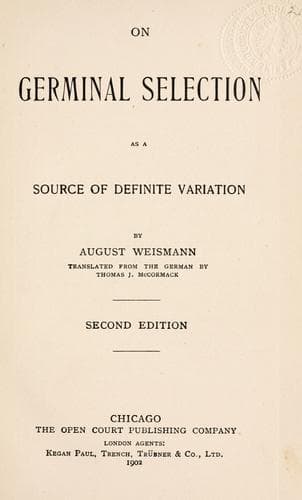
On Germinal Selection as a Source of Definite VariationWeismann, August
Science
On Germinal Selection as a Source of Definite Variation
Weismann, August
Variation (Biology)
It is conceded even by my opponents that the reason why one egg produces a
chicken and another a duck is not to be sought in external conditions, but
lies in a difference of the germinal substance. Nor can they deny that a
difference of germinal substance must also constitute the reason why a
slight _hereditary_ difference should exist between two filial organisms.
Should there now, in a possible instance, be present between them a second,
a third, a fourth, or a hundredth difference of hereditary character, each
of which could vary from the germ, then, certainly, some second, third,
fourth, or hundredth part of the germ must have been different; for whence,
otherwise, should the heredity of the differences be derived, seeing that
external influences affecting the organism in the course of evolution
induce only non-transmissible and transient deviations? But the fact that
every complex organism is actually composed of a very large number of parts
independently alterable from the germ, follows not only from the comparison
of allied species, but also and principally from the experiments long
conducted by man in artificial selection, and by the consequent and not
infrequent change of only a single part which happens to claim his
interest; for example, the tail-feathers of the cock, the fruit of the
gooseberry, the color of a single feather or group of feathers, and so on.
But a still more cogent proof is furnished by the degeneration of parts
grown {56} useless, for this process can be carried on to almost any extent
without the rest of the body necessarily becoming involved in sympathetic
alteration. Whole members may become rudimentary, like the hind limbs of
the whale, or it may be only single toes or parts of toes; the whole wing
may degenerate in the females of a butterfly species, or only a small
circular group of wing-scales, in the place of which a so-called "window"
arises. A single vein of the wing also may degenerate and disappear, or the
process may affect only a part of it, and this may happen in one sex only
of a species. In such cases the rest of the body may remain absolutely
unaltered; only a stone is taken out of the mosaic.
The assumption, thus, appears to me irresistible, that every such
hereditary and likewise independent and very slight change of the body
rests on some alteration of a _single_ definite particle of the germinal
substance, and not as Spencer and his followers would have it, on a change
of _all_ the units of the germ. If the germinal substance consisted wholly
of like units, then in every change, were it only of a single character,
_each_ of these units would have to undergo exactly the same modification.
Now I do not see how this is possible.
Public-domain text, read in full here on John Shaqi.
Reviews
Reviews
No reviews yet
Be the first to share your thoughts on this work.
Join the Discussion
Join the discussion
Sign in to leave a comment or review.
Sign InorCreate an account