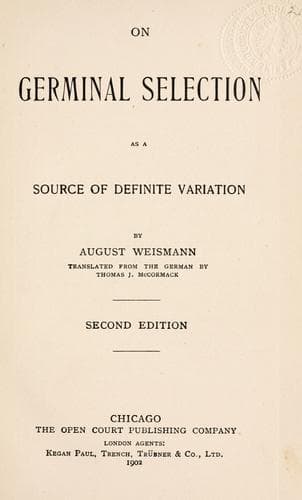
On Germinal Selection as a Source of Definite VariationWeismann, August
Science
On Germinal Selection as a Source of Definite Variation
Weismann, August
Variation (Biology)
In characterising as "least" weighty the old objection that the variations
are too small at the start to be useful and to be selected, I find myself
diametrically opposed to many writers of the present day, who have taken up
with renewed vigor this old stumbling block to the principle of selection.
Bateson[33] regards the deficient proof of the utility of initial stages as
the most serious objection that can be made to natural selection. New
organs must in the necessity of the case have first been imperfect; how,
then, could they have been selected since imperfect organs cannot be
useful? Answers from various quarters have already been {81} made to this
and to similar objections, and Darwin himself has referred to the fact that
even the smallest variations may have selective value; Dohrn, too, has
urged his principle of change of functions, which with regard to this
question of the utility of initial stages has certainly a wide
significance. Still, every transformation and new structure in the narrow
sense of the word does not rest on change of function, and neither Darwin
nor Wallace, nor any other more recent champion of the principle of
selection, can ever succeed in demonstrating in _every_ case the selective
value of an initial stage. One reason why this cannot be done is because
_in no case of morphological variation do we really know what these initial
stages are_. To say that "new organs were at first necessarily imperfect"
appears obvious enough, but it is at bottom a meaningless assertion, for it
is not only possible but certain, that "imperfect" organs may still have
selective value, and in by far the most cases have had selective value. The
fact that we see to-day a long graduated line of forest-butterflies which
possess resemblance to leaves and by this means are able in a measure to
conceal themselves from prying eyes, yet that this resemblance in many
species is very imperfect, in others more perfect, and in a very small
number very perfect, simply proves that even "imperfect" formations may be
of utility. The word "imperfect" in this connexion is itself very
imperfect, for it is utterly anthropomorphic and estimates the biological
value of a structure by our own peculiar artistic notions of its
faithfulness to a leaf-copy, whilst we are really concerned here only with
its protective value for the species in question, which is by no means
dependent merely on the faithfulness of the copying, on the {82}
faithfulness of the imitation, but on numerous other factors, such as the
frequency and sharp-sightedness of the enemies of the species, the
fertility of the species, their frequency and persecution in earlier
developmental stages, and so forth, in brief, on their need of protection
on the one hand and on their other means of protection on the other.
Public-domain text, read in full here on John Shaqi.
Reviews
Reviews
No reviews yet
Be the first to share your thoughts on this work.
Join the Discussion
Join the discussion
Sign in to leave a comment or review.
Sign InorCreate an account