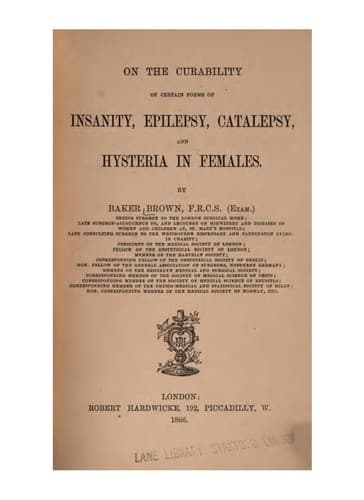
On the Curability of Certain Forms of Insanity, Epilepsy, Catalepsy, and Hysteria in FemalesBrown, Isaac Baker
Science
On the Curability of Certain Forms of Insanity, Epilepsy, Catalepsy, and Hysteria in Females
Brown, Isaac Baker
Clitoridectomy
It was gratifying to observe the early relief of her more severe
symptoms; by the third day the spasmodic attacks ceased, little or no
pain was complained of, and the improvement of the digestive system
was most marked, the patient enjoying chops, game, &c., within ten
days, and no longer “a martyr to flatulence and dyspepsia.” The
digestion was, however, easily deranged, and great care was necessary.
At the end of seven weeks, having already on several occasions been
driven out in a carriage, she was removed to the country, where she
remained for three weeks. It may be here stated that the patient
suffered much from the very sultry weather of September, and that
improvement was much more rapid when colder weather set in. On her
return, she was able to stand for a few minutes with her hands resting
on the shoulders of another. Remaining in town for some weeks, she
again left for the sea-side, where she stayed about three weeks, and
returned to town in the beginning of this year. Her condition is now
as follows:—
She looks remarkably well in the face, which has entirely lost its
expression of suffering. She is free from pain. Sensibility in the
lower extremities is perfect; their muscular power is greatly
improved. She can raise herself from a chair so as to rest on her
hands and feet, and is able to walk across her room, holding the hands
of her maid, who retreats before her. She sleeps well every night, and
her digestion is in very fair order. She is now able to sit up to all
her meals, and to sit in an upright chair for hours together, whereas
formerly she was constantly in the recumbent position.
CHAPTER V.
EPILEPTOID CONVULSIONS, OR HYSTERICAL EPILEPSY, WITH CASES.
In the chapter on hysteria, cases have been recorded of frequent
faintings, without spasms, and of spasmodic twitchings of limbs without
fainting, _i.e._ without loss of consciousness. We now come to cases
more marked and chronic, and having many of the characters of epilepsy.
They may be brought to us by the friends of the patient as genuine
epileptics. The diagnosis is in some cases difficult, but for the most
part easy. Dr. Russell Reynolds[4] has summed up the distinctive
features so ably that I cannot do better than quote his final remarks on
this subject:—
Footnote 4:
“Epilepsy: its Symptoms, Treatment, and Relation to other Chronic
Convulsive Diseases.” By J. Russell Reynolds, M.D. London: Churchill,
1861.
Public-domain text, read in full here on John Shaqi.
Reviews
Reviews
No reviews yet
Be the first to share your thoughts on this work.
Join the Discussion
Join the discussion
Sign in to leave a comment or review.
Sign InorCreate an account