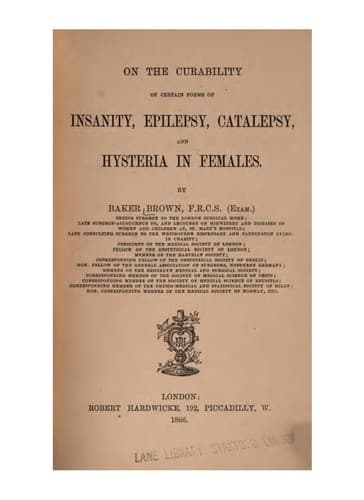
On the Curability of Certain Forms of Insanity, Epilepsy, Catalepsy, and Hysteria in Females — John Shaqi
On the Curability of Certain Forms of Insanity, Epilepsy, Catalepsy, and Hysteria in FemalesBrown, Isaac Baker
Science
On the Curability of Certain Forms of Insanity, Epilepsy, Catalepsy, and Hysteria in Females
Brown, Isaac Baker
Clitoridectomy
“The paroxysm resembles epilepsy, and sometimes closely, but it differs
in essential particulars. The difference is not one only of degree,
neither is it to be determined by the relation of hysterical convulsion
to pain, nor solely by the nature of the spasm. The diagnosis is to be
based upon a combination of features. The paroxysms follow hysteric
prodromata. At their onset there is constriction of the throat and
epigastrium; there are plaintive cries, sobbings, or laughings, which
reappear at the close; _sensibility, perception, and volition are
rarely, if ever, completely lost_; the face undergoes little change;
there is a twinkling movement of the eyelids; there is no marked
dilatation of the pupil; _there is rarely foaming or bitten tongue_; the
attacks are of long duration; respiratory movements are disorderly, but
there are no evidences of marked asphyxia; the pulse is small; there is
no stupor, but only general exhaustion after the attack; and although
the paroxysms may recur for many years, and be followed by a peculiar
kind of mania, they are rarely followed by dementia.”
I fully agree with Dr. Reynolds that what are called the “diagnostic
signs of hysteria,” as frequent micturition of clear pale urine,
tympanitis, nausea, &c., have no value in aiding our inquiry as to the
nature of these fits: they may be witnessed, and with as great
frequency, after epileptic seizures.
One practical point exists; namely, that in hysterical epilepsy the
patient seldom, I believe never, in falling hurts herself, whereas true
epileptics frequently suffer considerable bodily injuries.
CASE XXII. NINE YEARS’ ILLNESS—EPILEPTIFORM ATTACKS—THREE YEARS’
DURATION—OPERATION—CURE.
G. M., single; admitted into the London Surgical Home December 18,
1860.
_History._—For the last nine years has suffered greatly and regularly
during the menstrual periods. Has been much worse for the last three
years, during which time has, at each menstrual period, been
frequently taken in a fit, dropping down suddenly and fainting right
off; this state lasting for two or three hours. Being in service, this
has caused her much trouble, as none of her employers would keep her.
For the last six months has suffered severe pain over right ovary,
increased by exercise or pressure, and at the menstrual period.
Believing that the dysmenorrhœa and fits both arose from the same
cause, on January 3, clitoris was cut down to the base. After this
operation she never had a fit, and all untoward symptoms left her
except the dysmenorrhœa; she was therefore re-admitted May 27, 1861,
and there being some narrowing of the cervix, it was incised with the
hysterotome. June 21, catamenia came on without pain, and continued to
do so regularly. In July she was well enough to return to service.
Public-domain text, read in full here on John Shaqi.
Reviews
Reviews
No reviews yet
Be the first to share your thoughts on this work.
Join the Discussion
Join the discussion
Sign in to leave a comment or review.
Sign InorCreate an account