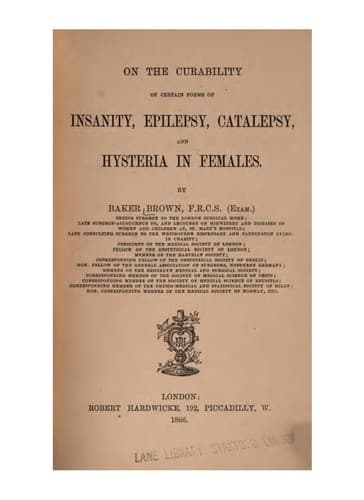
On the Curability of Certain Forms of Insanity, Epilepsy, Catalepsy, and Hysteria in FemalesBrown, Isaac Baker
Science
On the Curability of Certain Forms of Insanity, Epilepsy, Catalepsy, and Hysteria in Females
Brown, Isaac Baker
Clitoridectomy
This is no very new theory; but it has been for Dr. Handheld Jones, by a
large number of cases and experiments, as collated in his admirable work
on “Functional Nervous Disorders,”[1] to make it “abundantly clear that
the great majority of disorders we have to treat at the present time
show more or less marked indications of failure of nervous power.” Dr.
Jones confines himself “to such disorders as are termed functional;” and
I agree with him that “it seems a vain dispute, whether in strict
accuracy there are, or are not, any such disorders; ... for it is
perfectly certain that there are very grave disorders in which the most
careful scrutiny fails to detect any actual change, in which complete
recovery is perfectly possible, and in which the ‘juvantia’ are such as
to operate more in modifying the power of the organs than the texture.”
Dr. Jones then gives two typical cases of functional and organic
disease, between which, as he justly observes, “there intervene numerous
instances of more or less mixed character;” and adds, that “disease
which commences essentially as functional may end as organic.”
Footnote 1:
London, Churchill, 1864.
I am so pleased to be supported by my old friend and colleague in views
that I myself have long entertained, that I intend, without further
preface, to make his researches the whole substratum of my work; and
hope to show how, on the basis of Dr. Jones’s experiments, it is
possible to prove the philosophy of my own practice.
Whichever of the terms, “inhibitory influence” (Handfield Jones and
Lister), “reflex relaxation” (Brinton), or “reflex paralysis”
(Brown-Séquard), be used, the fact is ceded by all, that “the energetic
operation of an afferent nerve” (Lister), or some impression acting
injuriously on an afferent nerve (Handfield Jones), or, again, “an
actually existing irritation” (Brown-Séquard), exerts an injurious
effect on its nerve centre, this state being, as Dr. Brown-Séquard
thinks, increased or diminished according to the activity of the
irritation, and ceasing with its entire removal, or, more probably, as
Dr. Handfield Jones affirms, persisting after the cessation of the cause
which has morbidly affected it. This latter view appears to me the more
generally correct one, because it can hardly be expected that a gradual
disease will be suddenly removed, there having been no time for recovery
of nerve power.
Public-domain text, read in full here on John Shaqi.
Reviews
Reviews
No reviews yet
Be the first to share your thoughts on this work.
Join the Discussion
Join the discussion
Sign in to leave a comment or review.
Sign InorCreate an account