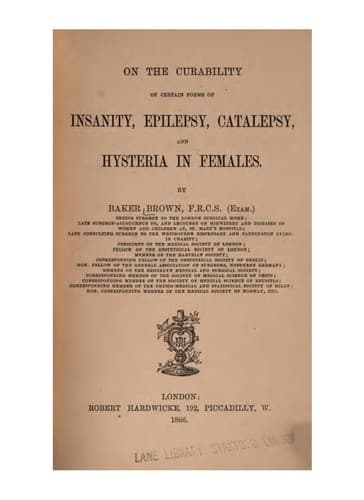
On the Curability of Certain Forms of Insanity, Epilepsy, Catalepsy, and Hysteria in Females — John Shaqi
On the Curability of Certain Forms of Insanity, Epilepsy, Catalepsy, and Hysteria in FemalesBrown, Isaac Baker
Science
On the Curability of Certain Forms of Insanity, Epilepsy, Catalepsy, and Hysteria in Females
Brown, Isaac Baker
Clitoridectomy
In Dr. Handfield Jones’s Lumleian Lectures, delivered last year before
the College of Physicians, he thus sums up his views on this
subject:—“The essential idea of the inhibitory theory is, that an
impression conveyed to a nervous centre by afferent nerves may weaken or
paralyze, instead of exciting, its action, either from the congenital or
acquired debility and sensitiveness of the nerve itself, or because the
impression is unduly intense or absolutely injurious. Both these things
have in every case to be considered—viz., the state of the nerve force,
and the kind and amount of impression, as the resulting phenomena will
vary with the variation of either.”
Dr. Jones next takes it as a matter of certainty, “that a nervous centre
may be more or less completely paralyzed without having undergone
organic change, in consequence of some enfeebling morbid influence;” and
quotes from Dr. Gull[2] “a most interesting instance of complete
paraplegia induced by sexual excess, in which nothing abnormal could be
detected in the cord, even by careful microscopy. This was paralysis
from simple exhaustion.”
Footnote 2:
“Guy’s Hospital Reports,” 1858. Case xvii.
Still continuing, Dr. Jones draws attention to the anatomical fact of
the remarkably close manner in which “the different nerve centres, or
parts of a nerve centre, are connected by commissural fibres,” and how,
“from a pathological point of view, the same connexion is often very
manifest. The general exhaustion induced by excess of venery,” and other
cases, “are examples which show how excessive consumption of nerve force
in one part weakens it also in others; and this can only be adequately
explained by the intricate commissural connexion between the various
centres.”
The truth of all these views is well exemplified, as Dr. Kidd has
stated, in cases of epilepsy, which “may originate only in irritation of
bad teeth acting on the brain, or worms irritating the nerves of the
stomach, and so on as to other peripheral irritations; the chief skill
being to find out the spot from which the irritation radiates.”
A case is also quoted by Dr. Jones, in the Lumleian Lectures, as having
occurred in the practice of Mr. Castle, of New York, where diseased
teeth produced paraplegia, which soon ceased after their removal.
Long and frequent observation convinced me that a large number of
affections peculiar to females, depended on loss of nerve power, and
that this was produced by peripheral irritation, arising originally in
some branches of the pudic nerve, more particularly the incident nerve
supplying the clitoris, and sometimes the small branches which supply
the vagina, perinæum, and anus.
Closer observation satisfied me that the greater or less severity of the
functional affections observed, depended on the amount and length of
irritation, and the consequent amount of loss of nerve power.
Nor are functional disorders the only consequence, but in some cases,
severe organic lesions.
Public-domain text, read in full here on John Shaqi.
Reviews
Reviews
No reviews yet
Be the first to share your thoughts on this work.
Join the Discussion
Join the discussion
Sign in to leave a comment or review.
Sign InorCreate an account