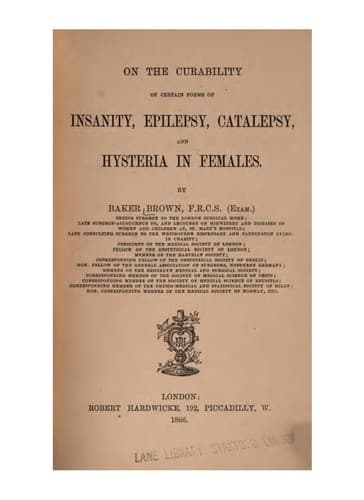
On the Curability of Certain Forms of Insanity, Epilepsy, Catalepsy, and Hysteria in FemalesBrown, Isaac Baker
Science
On the Curability of Certain Forms of Insanity, Epilepsy, Catalepsy, and Hysteria in Females
Brown, Isaac Baker
Clitoridectomy
Dr. J. C. Prichard, in writing of diseases of the nervous system, has
well said that “few diseases are better characterized by them symptoms
than epilepsy; yet in this instance there is such a variety in the
phenomena as renders it difficult to contrive a definition in a few
words which may comprehend every form of the complaint.”
I have said that when convulsions become chronic they are considered to
take on an epileptiform character. Now, although we know that in a few
cases involuntary spasm may take place in sleep, _i.e._ with loss of
consciousness, I think we may, for all general purposes, take as a
definition of epilepsy a chronic convulsive disease, each convulsive
attack being accompanied with “sudden and complete loss of
consciousness,” this latter symptom being considered by the late Dr.
Todd[5] as “the pathognomonic symptom of the disease,” but only, as Dr.
Reynolds[6] has shown, “when it occurs as a paroxysmal or occasional
event.”
Footnote 5:
_Medical Times and Gazette_, August 5, 1854, p. 129.
Footnote 6:
_Op. cit._, p. 31.
The causes of epilepsy are various—“partly physical, partly immaterial.”
Of the former are injuries and tumours of the brain or meninges,
intestinal worms, renal and biliary calculi, &c. &c. These are termed by
Dr. Handfield Jones[7] “eccentric causes.” As “centric causes,” he names
“poisoning of the blood from retention of excrementitious matter; this,
by deranging the nutrition of the nervous tissue, generates the abnormal
excitability, which then manifests itself without any special irritant.
Various causes of exhaustion, such as hæmorrhage and excessive
discharges, venereal excesses, prolonged want of sleep, unremitting
pain,” &c., are all “centric” causes of epilepsy.
Footnote 7:
_Op. cit._, p. 209.
Dr. Reynolds is right in considering epilepsy an idiopathic disease,
inasmuch as it occurs, without discoverable organic lesion with which it
can be associated, and because there is no structural lesion of the
brain, or spinal cord, to be found constantly associated with it; but
when he says that it is idiopathic because, “in many cases, eccentric
irritation cannot be shown to be the cause of the attacks,” I cannot go
with him. Epilepsy is a name signifying a disease, which may be
idiopathic, or may arise from a variety of causes; but that eccentric
irritation is a powerful and very frequent cause, there is not the
slightest doubt. Dr. Reynolds classes it as second of six in a table
given in his book, physical conditions being mentioned as first; and
finding, in a hundred cases, that 24·63 have no assignable cause, and
18·84 are doubtful, he gives 13·04 as due to eccentric irritation.
Public-domain text, read in full here on John Shaqi.
Reviews
Reviews
No reviews yet
Be the first to share your thoughts on this work.
Join the Discussion
Join the discussion
Sign in to leave a comment or review.
Sign InorCreate an account