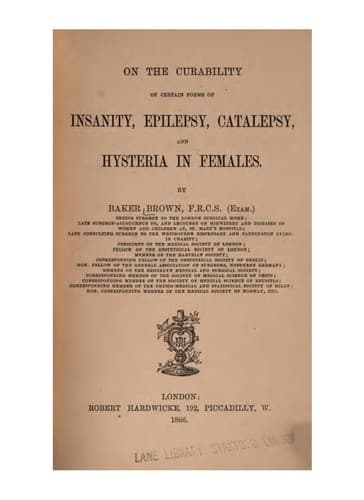
On the Curability of Certain Forms of Insanity, Epilepsy, Catalepsy, and Hysteria in FemalesBrown, Isaac Baker
Science
On the Curability of Certain Forms of Insanity, Epilepsy, Catalepsy, and Hysteria in Females
Brown, Isaac Baker
Clitoridectomy
In considering peripheral irritation of the pudic nerve as a cause of
this disease, we must, I think, consider mental emotion, which occupies
the highest rank in causes of epilepsy, in conjunction with that second
in the list,—eccentric irritation. I would, therefore, classify the
cause of epilepsy depending on such irritation as both eccentric and
centric. The former, inasmuch as it produces exhaustion, and, by
deranging the nutrition of the nervous tissue, generates abnormal
excitability; the latter, for that it is a physical excitant which is
not only “a mere provocative of the paroxysms, the convulsions being
supposed to ensue as the reflex results of irritation, but that it
actually _sets up_ in the nervous centres that state of excitability
which is the essence of the disorder.” Further still, looking on
epilepsy as a direct sequel of hysteria, when it is produced by
excitation of the pudic nerve, the patients are, in an eminent degree,
predisposed to the disease.
Women are also more naturally prone to epilepsy from mental emotion than
men; “Emotional disturbance being assigned,” says Dr. Reynolds, “as the
cause of their attacks in so many as 36 per cent., whereas in the male
sex there were only 13 per cent. who referred their diseases to that
cause.”
It would be out of place in a work of this nature to detail at length
the symptoms of these attacks. Whether they are truly epileptic will be
seen as the cases are related. I have been very careful to separate
those which seemed to be of an hysterical or epileptoid nature; and have
had the advantage of being able to show the greater number of them to
many eminent members of the medical profession, who have witnessed my
practice in the London Surgical Home.
CASE XXXIV. EPILEPTIC FITS—TWELVE YEARS’ DURATION—OPERATION—CURE.
S. F., æt. 41, single; admitted into the London Surgical Home Dec. 16,
1861.
_History._—Was always ailing, and hysterical for many years. Catamenia
appeared early, and always rather profuse. For the last twelve years
has suffered from epileptic fits; recurring frequently every week or
fortnight, and lately as often as every day. Has constant headaches;
is losing memory and all power of concentrating her ideas. Has no
premonition of seizure; falls down; is unconscious; has frequently
bitten her tongue; and “froths” at the mouth. Says she has had several
attacks of hæmatemesis. She was a dressmaker, and had so frequently,
on her way to or from business, fallen in the streets, that she had
been carried into almost every hospital in London, and a large number
of open surgeries.
_On examination_ there was found every indication of irritation about
the vulva, and also a small polypus of the os uteri, which latter was
large and patulous.
Dec. 19. Usual operation of excision; polypus uteri also removed.
Public-domain text, read in full here on John Shaqi.
Reviews
Reviews
No reviews yet
Be the first to share your thoughts on this work.
Join the Discussion
Join the discussion
Sign in to leave a comment or review.
Sign InorCreate an account