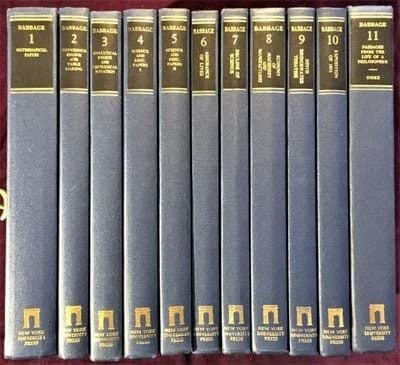
On the Economy of Machinery and ManufacturesBabbage, Charles
ReligionComparative
On the Economy of Machinery and Manufactures
Babbage, Charles
Machinery; Manufactures
12. Another process in the art of making needles furnishes an
example of one of the simplest contrivances which can come under
the denomination of a tool. After the needles have been arranged
in the manner just described, it is necessary to separate them
into two parcels, in order that their points may be all in one
direction. This is usually done by women and children. The
needles are placed sideways in a heap, on a table, in front of
each operator, just as they are arranged by the process above
described. From five to ten are rolled towards this person with
the forefinger of the left hand; this separates them a very small
space from each other, and each in its turn is pushed lengthwise
to the right or to the left, according to the direction of the
point. This is the usual process, and in it every needle passes
individually under the finger of the operator. A small alteration
expedites the process considerably: the child puts on the
forefinger of its right hand a small cloth cap or fingerstall,
and rolling out of the heap from six to twelve needles, he keeps
them down by the forefinger of the left hand, whilst he presses
the forefinger of the right hand gently against their ends: those
which have the points towards the right hand stick into the
fingerstall; and the child, removing the finger of the left hand,
slightly raises the needles sticking into the cloth, and then
pushes them towards the left side. Those needles which had their
eyes on the right hand do not stick into the finger cover, and
are pushed to the heap on the right side before the repetition of
this process. By means of this simple contrivance each movement
of the finger, from one side to the other, carries five or six
needles to their proper heap; whereas, in the former method,
frequently only one was moved, and rarely more than two or three
were transported at one movement to their place.
13. Various operations occur in the arts in which the
assistance of an additional hand would be a great convenience to
the workman, and in these cases tools or machines of the simplest
structure come to our aid: vices of different forms, in which the
material to be wrought is firmly grasped by screws, are of this
kind, and are used in almost every workshop; but a more striking
example may be found in the trade of the nail-maker.
Public-domain text, read in full here on John Shaqi.
Reviews
Reviews
No reviews yet
Be the first to share your thoughts on this work.
Join the Discussion
Join the discussion
Sign in to leave a comment or review.
Sign InorCreate an account