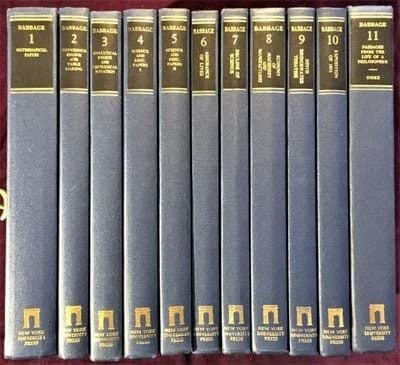
On the Economy of Machinery and ManufacturesBabbage, Charles
ReligionComparative
On the Economy of Machinery and Manufactures
Babbage, Charles
Machinery; Manufactures
Some kinds of nails, such as those used for defending the
soles of coarse shoes, called hobnails, require a particular form
of the head, which is made by the stroke of a die. The workman
holds one end of the rod of iron out of which he forms the nails
in his left hand; with his right hand he hammers the red-hot end
of it into a point, and cutting the proper length almost off,
bends it nearly at a right angle. He puts this into a hole in a
small stake-iron immediately under a hammer which is connected
with a treadle, and has a die sunk in its surface corresponding
to the intended form of the head; and having given one part of
the form to the head with the small hammer in his hand, he moves
the treadle with his foot, disengages the other hammer, and
completes the figure of the head; the returning stroke produced
by the movement of the treadle striking the finished nail out of
the hole in which it was retained. Without this substitution of
his foot for another hand, the workman would, probably, be
obliged to heat the nails twice over.
14. Another, though fortunately a less general substitution
of tools for human hands, is used to assist the labour of those
who are deprived by nature, or by accident, of some of their
limbs. Those who have had an opportunity of examining the
beautiful contrivances for the manufacture of shoes by machinery,
which we owe to the fertile invention of Mr Brunel, must have
noticed many instances in which the workmen were enabled to
execute their task with precision, although labouring under the
disadvantages of the loss of an arm or leg. A similar instance
occurs at Liverpool, in the Institution for the Blind, where a
machine is used by those afflicted with blindness, for weaving
sash-lines; it is said to have been the invention of a person
suffering under that calamity. Other examples might be mentioned
of contrivances for the use, the amusement, or the instruction of
the wealthier classes, who labour under the same natural
disadvantages. These triumphs of skill and ingenuity deserve a
double portion of our admiration when applied to mitigate the
severity of natural or accidental misfortune; when they supply
the rich with occupation and knowledge; when they relieve the
poor from the additional evils of poverty and want.
15. Division of the objects of machinery. There exists a
natural, although, in point of number, a very unequal division
amongst machines: they may be classed as; first, those which are
employed to produce power, and as, secondly, those which are
intended merely to transmit force and execute work. The first of
these divisions is of great importance, and is very limited in
the variety of its species, although some of those species
consist of numerous individuals.
Public-domain text, read in full here on John Shaqi.
Reviews
Reviews
No reviews yet
Be the first to share your thoughts on this work.
Join the Discussion
Join the discussion
Sign in to leave a comment or review.
Sign InorCreate an account