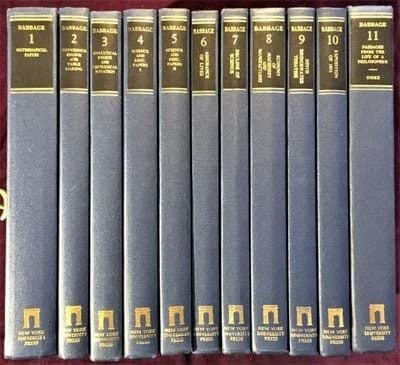
On the Economy of Machinery and ManufacturesBabbage, Charles
ReligionComparative
On the Economy of Machinery and Manufactures
Babbage, Charles
Machinery; Manufactures
Of that class of mechanical agents by which motion is
transmitted--the lever, the pulley, the wedge, and many others--
it has been demonstrated, that no power is gained by their use,
however combined. Whatever force is applied at one point can only
be exerted at some other, diminished by friction and other
incidental causes; and it has been further proved, that whatever
is gained in the rapidity of execution is compensated by the
necessity of exerting additional force. These two principles,
long since placed beyond the reach of doubt, cannot be too
constantly borne in mind. But in limiting our attempts to things
which are possible, we are still, as we hope to shew, possessed
of a field of inexhaustible research, and of advantages derived
from mechanical skill, which have but just begun to exercise
their influence on our arts, and may be pursued without limit
contributing to the improvement, the wealth, and the happiness of
our race.
16. Of those machines by which we produce power, it may be
observed, that although they are to us immense acquisitions, yet
in regard to two of the sources of this power--the force of wind
and of water--we merely make use of bodies in a state of motion
by nature; we change the directions of their movement in order to
render them subservient to our purposes, but we neither add to
nor diminish the quantity of motion in existence. When we expose
the sails of a windmill obliquely to the gale, we check the
velocity of a small portion of the atmosphere, and convert its
own rectilinear motion into one of rotation in the sails; we thus
change the direction of force, but we create no power. The same
may be observed with regard to the sails of a vessel; the
quantity of motion given by them is precisely the same as that
which is destroyed in the atmosphere. If we avail ourselves of a
descending stream to turn a water-wheel, we are appropriating a
power which nature may appear, at first sight, to be uselessly
and irrecoverably wasting, but which, upon due examination, we
shall find she is ever regaining by other processes. The fluid
which is falling from a higher to a lower level, carries with it
the velocity due to its revolution with the earth at a greater
distance from its centre. It will therefore accelerate, although
to an almost infinitesimal extent, the earth's daily rotation.
The sum of all these increments of velocity, arising from the
descent of all the falling waters on the earth's surface, would
in time become perceptible, did not nature, by the process of
evaporation, convey the waters back to their sources; and thus
again, by removing matter to a greater distance from the centre,
destroy the velocity generated by its previous approach.
Public-domain text, read in full here on John Shaqi.
Reviews
Reviews
No reviews yet
Be the first to share your thoughts on this work.
Join the Discussion
Join the discussion
Sign in to leave a comment or review.
Sign InorCreate an account