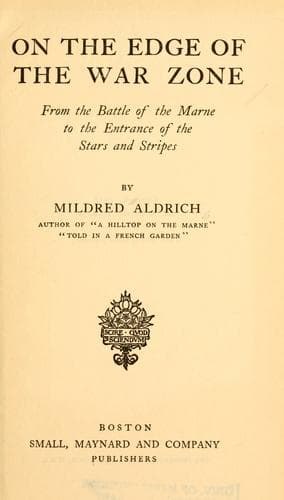
On the Edge of the War Zone: From the Battle of the Marne to the Entrance of the Stars and Stripes — John Shaqi
On the Edge of the War Zone: From the Battle of the Marne to the Entrance of the Stars and StripesAldrich, Mildred
History
On the Edge of the War Zone: From the Battle of the Marne to the Entrance of the Stars and Stripes
Aldrich, Mildred
World War, 1914-1918 -- Personal narratives
Of course, the vicious destruction of the great cathedral sends
shivers down my back. Every time I hear the big guns in that direction
I think of the last time we were there. Do you remember how we sat,
in the twilight of a rainy day, in our top-floor room, at the Lion d'Or, in
the wide window-seat, which brought us just at a level with that dear
tympanum, with its primitive stone carving of David and Goliath, and
all those wonderful animals sitting up so bravely on the lacework of
the parapet? Such a wave of pity goes over me when I think that not
only is it destroyed, but that future generations are deprived of seeing
it; that one of the greatest achievements of the hands of man, a work
which has withstood so many wars in what we called "savage times,"
before any claims were made for "Kultur," should have been
destroyed in our days. Men have come and men have gone
(apologies to Tennyson)--it is the law of living. But the wilful,
unnecessary destruction of the great works of man, the testimony
which one age has left as a heritage to all time--for that loss neither
Man nor Time has any consolation. It is a theft from future ages, and
for it Germany will merit the hatred of the world through the coming
generations.
IV
October 10, 1914
Amelie and I went up to Paris day before yesterday, for the first time
since the battle,--you see everything here dates "before" and "after"
the battle, and will for a long time.
Trains had been running between Paris and Meaux for ten days, and
will soon go as far as Chalons, where the Etat-Major was the last time
we heard of it. Isn't that pretty quick work? And with three big bridges
to build? But the army needed the road, and the engineers were at
work five days after the battle.
There are but few trains--none yet on our branch road--so we had to
go to Esbly. It took two hours to get to Paris--hardly more than twelve
miles. We simply crawled most of the way. We crept through the
tunnel this side of Lagny, and then stood on this side of the Marne,
and whistled and shrieked a long time before we began to wiggle
across the unfinished bridge, with workmen hanging up on the
derricks and scaffoldings in all sorts of perilous positions, and all sorts
of grotesque attitudes. I was glad when we were over.
Public-domain text, read in full here on John Shaqi.
Reviews
Reviews
No reviews yet
Be the first to share your thoughts on this work.
Join the Discussion
Join the discussion
Sign in to leave a comment or review.
Sign InorCreate an account