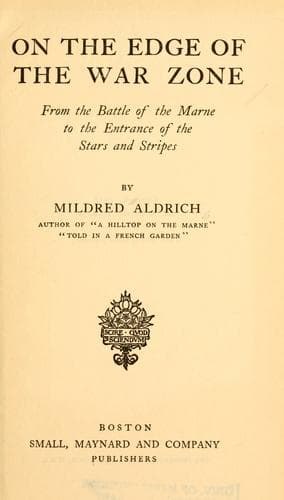
On the Edge of the War Zone: From the Battle of the Marne to the Entrance of the Stars and Stripes — John Shaqi
On the Edge of the War Zone: From the Battle of the Marne to the Entrance of the Stars and StripesAldrich, Mildred
History
On the Edge of the War Zone: From the Battle of the Marne to the Entrance of the Stars and Stripes
Aldrich, Mildred
World War, 1914-1918 -- Personal narratives
I found the town more normal than it was when I was there six weeks
ago. If I had not seen it in those first days of the mobilization it would
have seemed sadder than it did, and, by contrast, while it was not the
Paris that you know, it was quiet and peaceful,--no excitement of any
sort in the streets, practically no men anywhere. All the department
shops were open, but few people were in them, and very little to sell.
Many of the small shops were closed, and will be, I imagine, until the
end of the war. All the Austrian and German shops, and there were
many of them, are, of course, closed for good, making wide spaces of
closed shutters in the Avenue de l'Opéra and the rue de la Paix, and
the rue Scribe, where so many of the steamship offices are. That, and
the lack of omnibuses and tramways and the scarcity of cabs, makes
the once brilliant and active quarter look quite unnatural. However, it
gives one a chance to see how really handsome it is.
A great many of the most fashionable hotels are turned to hospitals,
and everywhere, especially along the Champs-Elysées, the flags of
the Red Cross float over once gay resorts, while big white bunting
signs extend across almost every other façade, carrying the name
and number of a hospital.
Every sort of business is running short-handed, and no big office or
bank is open between the hours of noon and two o'clock.
I saw no one--there was no one to see. I finished the little business I
had to do and then I went back to the station and sat on the terrace of
the café opposite, and, for an hour, I watched the soldiers going in at
one gate, and the public--Indian file--presenting its papers at another.
No carriages can enter the courtyard. No one can carry anything but
hand luggage, and porters are not allowed to pass the gates, so one
had to carry one's bundles one's self across the wide, paved court.
However, it is less trying to do this than it was in other days, as one
runs no risk from flying motor-cabs.
We did not leave Paris until six--it was already dark--and there were
few lights along the road. The Germans would love to destroy this
road, which is on the direct line to the front, but I cannot imagine a
bomb from an aeroplane reaching it at night, except by accident.
By the way, the attitude of the public towards these war airships is
queer. It seems a great deal more curiosity than fear. I had heard this
stated, and I had a chance to see it exemplified. Just as Amélie and I
were stumbling in the dusk over the rough pavement of the court, we
heard an aeroplane overhead. Everyone stopped short and looked
up. Some fool called "Une Taube--une Taube!" People already inside
the station turned and ran back to see. Of course, it wasn't a Taube.
Still, the fact that someone said it was, and that everyone ran out to
look up at it, was significant, as I am sure they would have done just
the same if it had really been a German machine.
Public-domain text, read in full here on John Shaqi.
Reviews
Reviews
No reviews yet
Be the first to share your thoughts on this work.
Join the Discussion
Join the discussion
Sign in to leave a comment or review.
Sign InorCreate an account