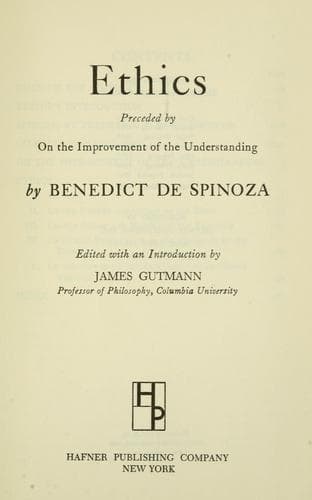
On the Improvement of the UnderstandingSpinoza, Benedictus de
PhilosophyPhilosophy
On the Improvement of the Understanding
Spinoza, Benedictus de
Free thought; Philosophy and religion
[49] (1) Let us now return to our proposition. (2) Up to the present,
we have, first, defined the end to which we desire to direct all our
thoughts; secondly, we have determined the mode of perception best
adapted to aid us in attaining our perfection; thirdly, we have
discovered the way which our mind should take, in order to make a good
beginning--namely, that it should use every true idea as a standard in
pursuing its inquiries according to fixed rules. (49:3) Now, in order
that it may thus proceed, our method must furnish us, first, with a
means of distinguishing a true idea from all other perceptions, and
enabling the mind to avoid the latter; secondly, with rules for
perceiving unknown things according to the standard of the true idea;
thirdly, with an order which enables us to avoid useless labor.
(49:4) When we became acquainted with this method, we saw that,
fourthly, it would be perfect when we had attained to the idea of the
absolutely perfect Being. (5) This is an observation which should be
made at the outset, in order that we may arrive at the knowledge of
such a being more quickly.
[50] (1) Let us then make a beginning with the first part of the method,
which is, as we have said, to distinguish and separate the true idea
from other perceptions, and to keep the mind from confusing with true
ideas those which are false, fictitious, and doubtful. (2) I intend to
dwell on this point at length, partly to keep a distinction so necessary
before the reader's mind, and also because there are some who doubt of
true ideas, through not having attended to the distinction between a true
perception and all others. (3) Such persons are like men who, while they
are awake, doubt not that they are awake, but afterwards in a dream, as
often happens, thinking that they are surely awake, and then finding that
they were in error, become doubtful even of being awake. (4) This state
of mind arises through neglect of the distinction between sleeping and
waking.
[51] (1) Meanwhile, I give warning that I shall not here give
essence of every perception, and explain it through its proximate
cause. (2) Such work lies in the province of philosophy. (3) I shall
confine myself to what concerns method--that is, to the character of
fictitious, false and doubtful perceptions, and the means of freeing
ourselves therefrom. (4) Let us then first inquire into the nature of
a fictitious idea.
Public-domain text, read in full here on John Shaqi.
Reviews
Reviews
No reviews yet
Be the first to share your thoughts on this work.
Join the Discussion
Join the discussion
Sign in to leave a comment or review.
Sign InorCreate an account