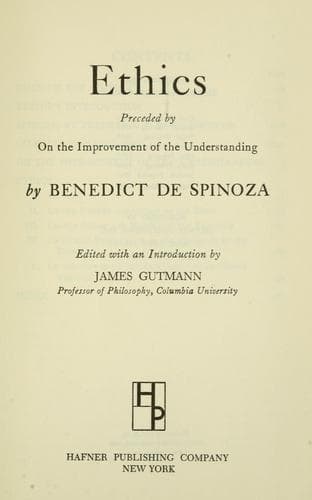
On the Improvement of the UnderstandingSpinoza, Benedictus de
PhilosophyPhilosophy
On the Improvement of the Understanding
Spinoza, Benedictus de
Free thought; Philosophy and religion
[52] (1) Every perception has for its object either a thing considered
as existing, or solely the essence of a thing. (2) Now "fiction" is
chiefly occupied with things considered as existing. (3) I will,
therefore, consider these first--I mean cases where only the existence
of an object is feigned, and the thing thus feigned is understood, or
assumed to be understood. (4) For instance, I feign that Peter, whom
I know to have gone home, is gone to see me, [r] or something of that
kind. (5) With what is such an idea concerned? (6) It is concerned
with things possible, and not with things necessary or impossible.
[53] (1) I call a thing impossible when its existence would imply a
contradiction; necessary, when its non-existence would imply a
contradiction; possible, when neither its existence nor its
non-existence imply a contradiction, but when the necessity or
impossibility of its nature depends on causes unknown to us, while
we feign that it exists. (2) If the necessity or impossibility of
its existence depending on external causes were known to us, we
could not form any fictitious hypotheses about it;
[54] (1) Whence it follows that if there be a God, or omniscient
Being, such an one cannot form fictitious hypotheses. (2) For,
as regards ourselves, when I know that I exist, [s] I cannot
hypothesize that I exist or do not exist, any more than I can
hypothesize an elephant that can go through the eye of a needle;
nor when I know the nature of God, can I hypothesize that He
or does not exist. [t] (54:3) The same thing must be said of the
Chimaera, whereof the nature implies a contradiction. (4) From
these considerations, it is plain, as I have already stated, that
fiction cannot be concerned with eternal truths. [u]
[55] (1) But before proceeding further, I must remark, in passing,
that the difference between the essence of one thing and the essence
of another thing is the same as that which exists between the reality
or existence of one thing and the reality or existence of another;
therefore, if we wished to conceive the existence, for example,
of Adam, simply by means of existence in general, it would be the
same as if, in order to conceive his existence, we went back to the
nature of being, so as to define Adam as a being. (2) Thus, the more
existence is conceived generally, the more is it conceived confusedly
and the more easily can it be ascribed to a given object.
(55:3) Contrariwise, the more it is conceived particularly, the more
is it understood clearly, and the less liable is it to be ascribed,
through negligence of Nature's order, to anything save its proper
object. (4) This is worthy of remark.
Public-domain text, read in full here on John Shaqi.
Reviews
Reviews
No reviews yet
Be the first to share your thoughts on this work.
Join the Discussion
Join the discussion
Sign in to leave a comment or review.
Sign InorCreate an account