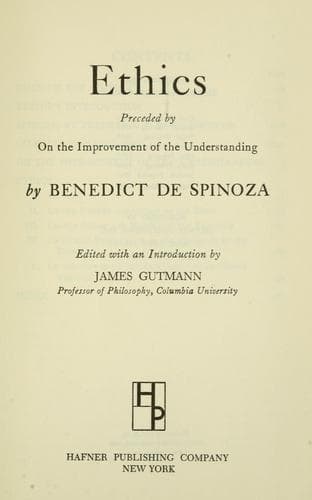
On the Improvement of the UnderstandingSpinoza, Benedictus de
PhilosophyPhilosophy
On the Improvement of the Understanding
Spinoza, Benedictus de
Free thought; Philosophy and religion
[58] (1) Let us now pass on to the fictions concerned with essences
only, or with some reality or existence simultaneously. (2) Of
these we must specially observe that in proportion as the mind's
understanding is smaller, and its experience multiplex, so will its
power of coining fictions be larger, whereas as its understanding
increases, its capacity for entertaining fictitious ideas becomes
less. (58:3) For instance, in the same way as we are unable, while
we are thinking, to feign that we are thinking or not thinking, so,
also, when we know the nature of body we cannot imagine an infinite
fly; or, when we know the nature of the soul, [z] we cannot imagine
it as square, though anything may be expressed verbally. (4) But,
as we said above, the less men know of nature the more easily can
they coin fictitious ideas, such as trees speaking, men instantly
changed into stones, or into fountains, ghosts appearing in mirrors,
something issuing from nothing, even gods changed into beasts and men
and infinite other absurdities of the same kind.
[59] (1) Some persons think, perhaps, that fiction is limited by
fiction, and not by understanding; in other words, after I have
formed some fictitious idea, and have affirmed of my own free will
that it exists under a certain form in nature, I am thereby
precluded from thinking of it under any other form. (2) For
instance, when I have feigned (to repeat their argument) that the
nature of body is of a certain kind, and have of my own free will
desired to convince myself that it actually exists under this
form, I am no longer able to hypothesize that a fly, for example,
is infinite; so, when I have hypothesized the essence of the soul,
I am not able to think of it as square, &c.
[60] (1) But these arguments demand further inquiry. (2) First,
their upholders must either grant or deny that we can understand
anything. If they grant it, then necessarily the same must be
said of understanding, as is said of fiction. (3) If they deny
it, let us, who know that we do know something, see what they
mean. (4) They assert that the soul can be conscious of, and
perceive in a variety of ways, not itself nor things which
exist, but only things which are neither in itself nor anywhere
else, in other words, that the soul can, by its unaided power,
create sensations or ideas unconnected with things. (5) In fact,
they regard the soul as a sort of god. (60:6) Further, they assert
that we or our soul have such freedom that we can constrain
ourselves, or our soul, or even our soul's freedom. (7) For,
after it has formed a fictitious idea, and has given its assent
thereto, it cannot think or feign it in any other manner, but is
constrained by the first fictitious idea to keep all its other
thoughts in harmony therewith. (8) Our opponents are thus driven
to admit, in support of their fiction, the absurdities which I
have just enumerated; and which are not worthy of rational
refutation.
Public-domain text, read in full here on John Shaqi.
Reviews
Reviews
No reviews yet
Be the first to share your thoughts on this work.
Join the Discussion
Join the discussion
Sign in to leave a comment or review.
Sign InorCreate an account