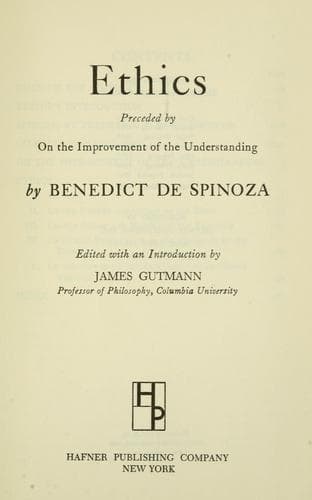
On the Improvement of the UnderstandingSpinoza, Benedictus de
PhilosophyPhilosophy
On the Improvement of the Understanding
Spinoza, Benedictus de
Free thought; Philosophy and religion
[61] (1) While leaving such persons in their error, we will take
care to derive from our argument with them a truth serviceable for
our purpose, namely, [61a] that the mind, in paying attention to
a thing hypothetical or false, so as to meditate upon it and
understand it, and derive the proper conclusions in due order
therefrom, will readily discover its falsity; and if the thing
hypothetical be in its nature true, and the mind pays attention
to it, so as to understand it, and deduce the truths which are
derivable from it, the mind will proceed with an uninterrupted
series of apt conclusions; in the same way as it would at once
discover (as we showed just now) the absurdity of a false
hypothesis, and of the conclusions drawn from it.
[62] (1) We need, therefore, be in no fear of forming hypotheses,
so long as we have a clear and distinct perception of what is
involved. (2) For, if we were to assert, haply, that men are
suddenly turned into beasts, the statement would be extremely
general, so general that there would be no conception, that is,
no idea or connection of subject and predicate, in our mind.
(3) If there were such a conception we should at the same time
be aware of the means and the causes whereby the event took place.
(4) Moreover, we pay no attention to the nature of the subject
and the predicate.
[63] (1) Now, if the first idea be not fictitious, and if all the
other ideas be deduced therefrom, our hurry to form fictitious ideas
will gradually subside. (2) Further, as a fictitious idea cannot be
clear and distinct, but is necessarily confused, and as all confusion
arises from the fact that the mind has only partial knowledge of a
thing either simple or complex, and does not distinguish between the
known and the unknown, and, again, that it directs its attention
promiscuously to all parts of an object at once without making
distinctions, it follows, first, that if the idea be of something
very simple, it must necessarily be clear and distinct. (3) For
a very simple object cannot be known in part, it must either be
known altogether or not at all.
[64] (1) Secondly, it follows that if a complex object be divided by
thought into a number of simple component parts, and if each be
regarded separately, all confusion will disappear. (2) Thirdly, it
follows that fiction cannot be simple, but is made up of the blending
of several confused ideas of diverse objects or actions existent in
nature, or rather is composed of attention directed to all such ideas
at once, [64b] and unaccompanied by any mental assent.
(64:3) Now a fiction that was simple would be clear and distinct,
and therefore true, also a fiction composed only of distinct ideas
would be clear and distinct, and therefore true. (4) For instance,
when we know the nature of the circle and the square, it is
impossible for us to blend together these two figures, and to
hypothesize a square circle, any more than a square soul, or things
of that kind.
Public-domain text, read in full here on John Shaqi.
Reviews
Reviews
No reviews yet
Be the first to share your thoughts on this work.
Join the Discussion
Join the discussion
Sign in to leave a comment or review.
Sign InorCreate an account