On the Improvement of the Understanding — John Shaqi
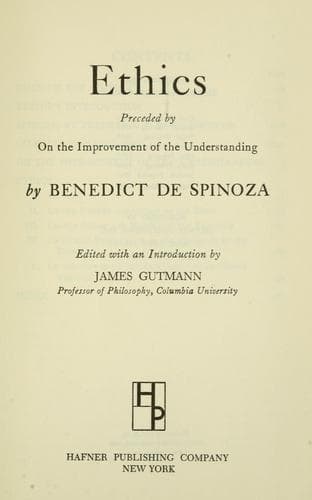
On the Improvement of the UnderstandingSpinoza, Benedictus de
PhilosophyPhilosophy
On the Improvement of the Understanding
Spinoza, Benedictus de
Free thought; Philosophy and religion
[90] (1) Let us also beware of another great cause of confusion,
which prevents the understanding from reflecting on itself.
(2) Sometimes, while making no distinction between the imagination
and the intellect, we think that what we more readily imagine is
clearer to us; and also we think that what we imagine we understand.
(3) Thus, we put first that which should be last: the true order of
progression is reversed, and no legitimate conclusion is drawn.
[91] [91e] (1) Now, in order at length to pass on to the second
part of this method, I shall first set forth the object aimed at,
and next the means for its attainment. (2) The object aimed at
is the acquisition of clear and distinct ideas, such as are
produced by the pure intellect, and not by chance physical motions.
(3) In order that all ideas may be reduced to unity, we shall
endeavor so to associate and arrange them that our mind may, as far
as possible, reflect subjectively the reality of nature, both as
a whole and as parts.
[92] (1) As for the first point, it is necessary (as we have said)
for our purpose that everything should be conceived, either solely
through its essence, or through its proximate cause. (2) If the
thing be self-existent, or, as is commonly said, the cause of
itself, it must be understood through its essence only; if it be
not self-existent, but requires a cause for its existence, it must
be understood through its proximate cause. (3) For, in reality,
the knowledge, [92f] of an effect is nothing else than the
acquisition of more perfect knowledge of its cause.
[93] (1) Therefore, we may never, while we are concerned with
inquiries into actual things, draw any conclusion from
abstractions; we shall be extremely careful not to confound that
which is only in the understanding with that which is in the
thing itself. (2) The best basis for drawing a conclusion will
be either some particular affirmative essence, or a true and
legitimate definition. (93:3) For the understanding cannot descend
from universal axioms by themselves to particular things, since
axioms are of infinite extent, and do not determine the
understanding to contemplate one particular thing more than
another.
[94] (1) Thus the true method of discovery is to form thoughts
from some given definition. (2) This process will be the
more fruitful and easy in proportion as the thing given be
better defined. (3) Wherefore, the cardinal point of all this
second part of method consists in the knowledge of the conditions
of good definition, and the means of finding them. (4) I will
first treat of the conditions of definition.
Public-domain text, read in full here on John Shaqi.
Reviews
Reviews
No reviews yet
Be the first to share your thoughts on this work.
Join the Discussion
Join the discussion
Sign in to leave a comment or review.
Sign InorCreate an account