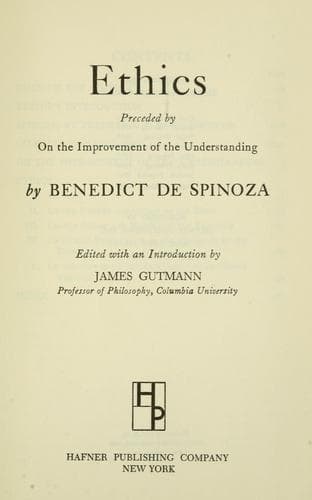
On the Improvement of the Understanding — John Shaqi
On the Improvement of the UnderstandingSpinoza, Benedictus de
PhilosophyPhilosophy
On the Improvement of the Understanding
Spinoza, Benedictus de
Free thought; Philosophy and religion
[85] (1) As regards as a true idea, we have shown that it is simple
or compounded of simple ideas; that it shows how and why something
is or has been made; and that its subjective effects in the soul
correspond to the actual reality of its object. (2) This conclusion
is identical with the saying of the ancients, that true proceeds
from cause to effect; though the ancients, so far as I know,
never formed the conception put forward here that the soul acts
according to fixed laws, and is as it were an immaterial automaton.
[86] (1) Hence, as far as is possible at the outset, we have
acquired a knowledge of our understanding, and such a standard of
a true idea that we need no longer fear confounding truth with
falsehood and fiction. (2) Neither shall we wonder why we
understand some things which in nowise fall within the scope of
the imagination, while other things are in the imagination but
wholly opposed to the understanding, or others, again, which
agree therewith. (3) We now know that the operations, whereby the
effects of imagination are produced, take place under other laws
quite different from the laws of the understanding, and that the
mind is entirely passive with regard to them.
[87] (1) Whence we may also see how easily men may fall into grave
errors through not distinguishing accurately between the imagination
and the understanding; such as believing that extension must be
localized, that it must be finite, that its parts are really distinct
one from the other, that it is the primary and single foundation of
all things, that it occupies more space at one time than at another
and other similar doctrines, all entirely opposed to truth, as we
shall duly show.
[88] (1) Again, since words are a part of the imagination--that is,
since we form many conceptions in accordance with confused
arrangements of words in the memory, dependent on particular bodily
conditions,--there is no doubt that words may, equally with the
imagination, be the cause of many and great errors, unless we
strictly on our guard.
[89] (1) Moreover, words are formed according to popular fancy and
intelligence, and are, therefore, signs of things as existing in the
imagination, not as existing in the understanding. (2) This is
evident from the fact that to all such things as exist only in the
understanding, not in the imagination, negative names are often
given, such as incorporeal, infinite, &c. (3) So, also, many
conceptions really affirmative are expressed negatively, and vice
versa, such as uncreate, independent, infinite, immortal, &c.,
inasmuch as their contraries are much more easily imagined, and,
therefore, occurred first to men, and usurped positive names.
(89:4) Many things we affirm and deny, because the nature of words
allows us to do so, though the nature of things does not. (5) While
we remain unaware of this fact, we may easily mistake falsehood for
truth.
Public-domain text, read in full here on John Shaqi.
Reviews
Reviews
No reviews yet
Be the first to share your thoughts on this work.
Join the Discussion
Join the discussion
Sign in to leave a comment or review.
Sign InorCreate an account