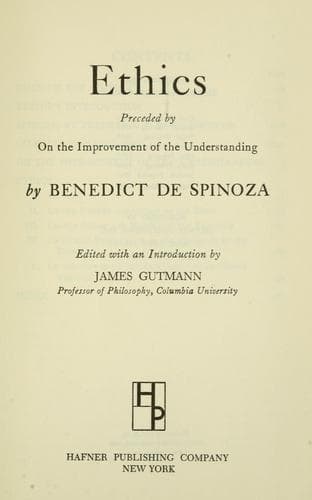
On the Improvement of the UnderstandingSpinoza, Benedictus de
PhilosophyPhilosophy
On the Improvement of the Understanding
Spinoza, Benedictus de
Free thought; Philosophy and religion
IV. Lastly, though this is not absolutely necessary, it should
be possible to deduce from the definition all the properties
of the thing defined.
All these rules become obvious to anyone giving strict
attention to the matter.
[98] (1) I have also stated that the best basis for drawing a
conclusion is a particular affirmative essence. (2) The more
specialized the idea is, the more it is distinct, and therefore
clear. (3) Wherefore a knowledge of particular things should
be sought for as diligently as possible.
[99] (1) As regards the order of our perceptions, and the manner
in which they should be arranged and united, it is necessary that,
as soon as is possible and rational, we should inquire whether
there be any being (and, if so, what being), that is the cause
of all things, so that its essence, represented in thought, may
be the cause of all our ideas, and then our mind will to the
utmost possible extent reflect nature. (2) For it will possess,
subjectively, nature's essence, order, and union. (3) Thus we
can see that it is before all things necessary for us to deduce
all our ideas from physical things--that is, from real entities,
proceeding, as far as may be, according to the series of causes,
from one real entity to another real entity, never passing to
universals and abstractions, either for the purpose of deducing
some real entity from them, or deducing them from some real
entity. (4) Either of these processes interrupts the true
progress of the understanding.
[100] (1) But it must be observed that, by the series of causes
and real entities, I do not here mean the series of particular
and mutable things, but only the series of fixed and eternal
things. (2) It would be impossible for human infirmity to follow
up the series of particular mutable things, both on account
their multitude, surpassing all calculation, and on account of
the infinitely diverse circumstances surrounding one and the same
thing, any one of which may be the cause of its existence or
non-existence. (3) Indeed, their existence has no connection
with their essence, or (as we have said already) is not an
eternal truth.
[101] (1) Neither is there any need that we should understand
their series, for the essences of particular mutable things are
not to be gathered from their series or order of existence,
which would furnish us with nothing beyond their extrinsic
denominations, their relations, or, at most, their circumstances,
all of which are very different from their inmost essence.
(101:2) This inmost essence must be sought solely from fixed and
eternal things, and from the laws, inscribed (so to speak) in
those things as in their true codes, according to which all
particular things take place and are arranged; nay, these mutable
particular things depend so intimately and essentially (so to
phrase it) upon the fixed things, that they cannot either be
conceived without them.
Public-domain text, read in full here on John Shaqi.
Reviews
Reviews
No reviews yet
Be the first to share your thoughts on this work.
Join the Discussion
Join the discussion
Sign in to leave a comment or review.
Sign InorCreate an account