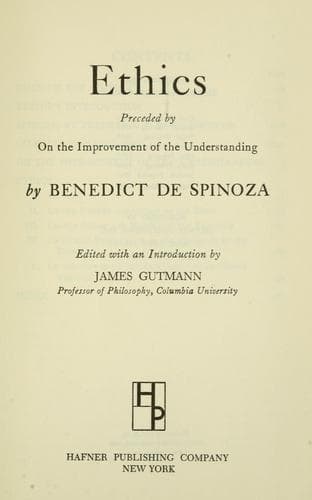
On the Improvement of the UnderstandingSpinoza, Benedictus de
PhilosophyPhilosophy
On the Improvement of the Understanding
Spinoza, Benedictus de
Free thought; Philosophy and religion
[102] (1) But, though this be so, there seems to be no small
difficulty in arriving at the knowledge of these particular things,
for to conceive them all at once would far surpass the powers of
the human understanding. (2) The arrangement whereby one thing is
understood, before another, as we have stated, should not be sought
from their series of existence, nor from eternal things. (3) For
the latter are all by nature simultaneous. (4) Other aids are
therefore needed besides those employed for understanding eternal
things and their laws. (5) However, this is not the place to recount
such aids, nor is there any need to do so, until we have acquired a
sufficient knowledge of eternal things and their infallible laws,
and until the nature of our senses has become plain to us.
[103] (1) Before betaking ourselves to seek knowledge of particular
things, it will be seasonable to speak of such aids, as all tend to
teach us the mode of employing our senses, and to make certain
experiments under fixed rules and arrangements which may suffice to
determine the object of our inquiry, so that we may therefrom infer
what laws of eternal things it has been produced under, and may gain
an insight into its inmost nature, as I will duly show. (2) Here,
to return to my purpose, I will only endeavor to set forth what seems
necessary for enabling us to attain to knowledge of eternal things,
and to define them under the conditions laid down above.
[104] (1) With this end, we must bear in mind what has already been
stated, namely, that when the mind devotes itself to any thought, so
as to examine it, and to deduce therefrom in due order all the
legitimate conclusions possible, any falsehood which may lurk in the
thought will be detected; but if the thought be true, the mind will
readily proceed without interruption to deduce truths from it.
(104:2) This, I say, is necessary for our purpose, for our thoughts
may be brought to a close by the absence of a foundation.
[105] (1) If, therefore, we wish to investigate the first thing of
all, it will be necessary to supply some foundation which may direct
our thoughts thither. (2) Further, since method is reflective
knowledge, the foundation which must direct our thoughts can be
nothing else than the knowledge of that which constitutes the reality
of truth, and the knowledge of the understanding, its properties, and
powers. (3) When this has been acquired we shall possess a foundation
wherefrom we can deduce our thoughts, and a path whereby the intellect,
according to its capacity, may attain the knowledge of eternal things,
allowance being made for the extent of the intellectual powers.
Public-domain text, read in full here on John Shaqi.
Reviews
Reviews
No reviews yet
Be the first to share your thoughts on this work.
Join the Discussion
Join the discussion
Sign in to leave a comment or review.
Sign InorCreate an account