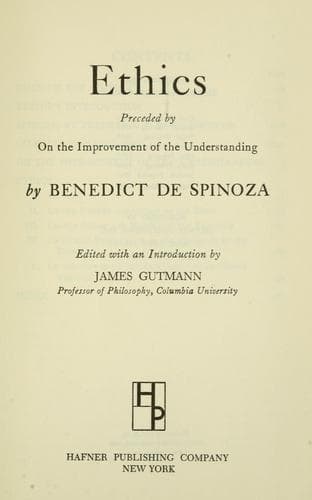
On the Improvement of the UnderstandingSpinoza, Benedictus de
PhilosophyPhilosophy
On the Improvement of the Understanding
Spinoza, Benedictus de
Free thought; Philosophy and religion
[106] (1) If, as I stated in the first part, it belongs to the nature
of thought to form true ideas, we must here inquire what is meant by
the faculties and power of the understanding. (2) The chief part of
our method is to understand as well as possible the powers of the
intellect, and its nature; we are, therefore, compelled (by the
considerations advanced in the second part of the method) necessarily
to draw these conclusions from the definition itself of thought and
understanding.
[107] (1) But, so far as we have not got any rules for finding
definitions, and, as we cannot set forth such rules without a
previous knowledge of nature, that is without a definition of the
understanding and its power, it follows either that the definition
of the understanding must be clear in itself, or that we can
understand nothing. (2) Nevertheless this definition is not
absolutely clear in itself; however, since its properties, like
all things that we possess through the understanding, cannot be
known clearly and distinctly, unless its nature be known previously,
understanding makes itself manifest, if we pay attention to its
properties, which we know clearly and distinctly. (3) Let us,
then, enumerate here the properties of the understanding, let us
examine them, and begin by discussing the instruments for research
which we find innate in us. See [31]
[108] (1) The properties of the understanding which I have chiefly
remarked, and which I clearly understand, are the following:--
I. (2) It involves certainty--in other words, it knows that a thing
exists in reality as it is reflected subjectively.
II. (108:3) That it perceives certain things, or forms some ideas
absolutely, some ideas from others. (4) Thus it forms the
idea of quantity absolutely, without reference to any other
thoughts; but ideas of motion it only forms after taking into
consideration the idea of quantity.
III. (108:5) Those ideas which the understanding forms absolutely
express infinity; determinate ideas are derived from other
ideas. (6) Thus in the idea of quantity, perceived by means
of a cause, the quantity is determined, as when a body is
perceived to be formed by the motion of a plane, a plane by
the motion of a line, or, again, a line by the motion of a
point. (7) All these are perceptions which do not serve
towards understanding quantity, but only towards determining
it. (108:8) This is proved by the fact that we conceive them
as formed as it were by motion, yet this motion is not perceived
unless the quantity be perceived also; we can even prolong the
motion to form an infinite line, which we certainly could not do
unless we had an idea of infinite quantity.
IV. (9) The understanding forms positive ideas before forming
negative ideas.
Public-domain text, read in full here on John Shaqi.
Reviews
Reviews
No reviews yet
Be the first to share your thoughts on this work.
Join the Discussion
Join the discussion
Sign in to leave a comment or review.
Sign InorCreate an account