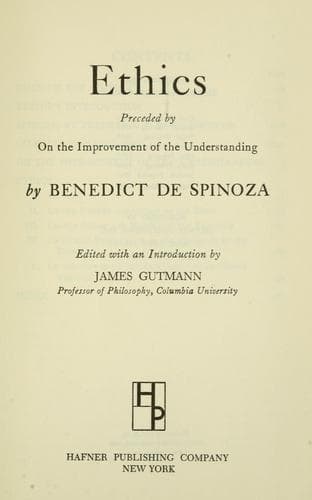
On the Improvement of the UnderstandingSpinoza, Benedictus de
PhilosophyPhilosophy
On the Improvement of the Understanding
Spinoza, Benedictus de
Free thought; Philosophy and religion
[e] There is for the sciences but one end, to which they should
all be directed.
[f] (1) In this case we do not understand anything of the cause
from the consideration of it in the effect. (2) This is
sufficiently evident from the fact that the cause is only
spoken of in very general terms, such as--there exists then
something; there exists then some power, &c.; or from the
that we only express it in a negative manner--it is not
or that, &c. (3) In the second case something is ascribed
to the cause because of the effect, as we shall show in an
example, but only a property, never an essence.
[g] (1) From this example may be clearly seen what I have just
drawn attention to. (2) For through this union we understand
nothing beyond the sensation, the effect, to wit, from which
we inferred the cause of which we understand nothing.
[h] (1) A conclusion of this sort, though it be certain, is yet
not to be relied on without great caution; for unless we are
exceedingly careful we shall forthwith fall into error.
(2) When things are conceived thus abstractedly, and not
through their true essence, they are apt to be confused by the
imagination. (3) For that which is in itself one, men imagine
to be multiplex. (4) To those things which are conceived
abstractedly, apart, and confusedly, terms are applied which are
apt to become wrested from their strict meaning, and bestowed on
things more familiar; whence it results that these latter are
imagined in the same way as the former to which the terms were
originally given.
[i] I shall here treat a little more in detail of experience,
and shall examine the method adopted by the Empirics,
and by recent philosophers.
[k] By native strength, I mean that not bestowed on us by external
causes, as I shall afterwards explain in my philosophy.
[l] Here I term them operations: I shall explain their nature
in my philosophy.
[m] I shall take care not only to demonstrate what I have just
advanced, but also that we have hitherto proceeded rightly,
and other things needful to be known.
[33note1] (1) In modern language, "the idea may become the
subject of another presentation." (2) Objectivus generally
corresponds to the modern "subjective," formalis to the
modern "objective." [Trans.- Note 1]
[n] (1) Observe that we are not here inquiring how the first
subjective essence is innate in us. (2) This belongs to an
investigation into nature, where all these matters are amply
explained, and it is shown that without ideas neither
affirmation, nor negation, nor volition are possible.
[o] The nature of mental search is explained in my philosophy.
[p] To be connected with other things is to be produced by them,
or to produce them.
[q] In the same way as we have here no doubt of the truth of
our knowledge.
Public-domain text, read in full here on John Shaqi.
Reviews
Reviews
No reviews yet
Be the first to share your thoughts on this work.
Join the Discussion
Join the discussion
Sign in to leave a comment or review.
Sign InorCreate an account