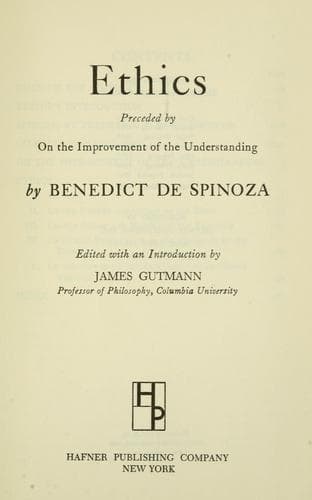
On the Improvement of the UnderstandingSpinoza, Benedictus de
PhilosophyPhilosophy
On the Improvement of the Understanding
Spinoza, Benedictus de
Free thought; Philosophy and religion
[r] See below the note on hypotheses, whereof we have a clear
understanding; the fiction consists in saying that such
hypotheses exist in heavenly bodies.
[s] (1) As a thing, when once it is understood, manifests itself,
we have need only of an example without further proof.
(2) In the same way the contrary has only to be presented to
our minds to be recognized as false, as will forthwith appear
when we come to discuss fiction concerning essences.
[t] Observe, that although many assert that they doubt whether God
exists, they have nought but his name in their minds, or else
some fiction which they call God: this fiction is not in
harmony with God's real nature, as we will duly show.
[u] (1) I shall presently show that no fiction can concern eternal
truths. By an eternal truth, I mean that which being positive
could never become negative. (2) Thus it is a primary and
eternal truth that God exists, but it is not an eternal truth
that Adam thinks. (3) That the Chimaera does not exist is an
eternal truth, that Adam does not think is not so.
[x] (1) Afterwards, when we come to speak of fiction that is
concerned with essences, it will be evident that fiction never
creates or furnishes the mind with anything new; only such things
as are already in the brain or imagination are recalled to the
memory, when the attention is directed to them confusedly and all
at once. (2) For instance, we have remembrance of spoken words
and of a tree; when the mind directs itself to them confusedly,
it forms the notion of a tree speaking. (3) The same may be said
of existence, especially when it is conceived quite generally as
an entity; it is then readily applied to all things together in
the memory. (4) This is specially worthy of remark.
[y] We must understand as much in the case of hypotheses put forward
to explain certain movements accompanying celestial phenomena;
but from these, when applied to the celestial motions, we any
draw conclusions as to the nature of the heavens, whereas this
last may be quite different, especially as many other causes are
conceivable which would account for such motions.
[z] (1) It often happens that a man recalls to mind this word soul,
and forms at the same time some corporeal image: as the two
representations are simultaneous, he easily thinks that he
imagines and feigns a corporeal soul: thus confusing the name
with the thing itself. (2) I here beg that my readers will not
be in a hurry to refute this proposition; they will, I hope,
have no mind to do so, if they pay close attention to the
examples given and to what follows.
Public-domain text, read in full here on John Shaqi.
Reviews
Reviews
No reviews yet
Be the first to share your thoughts on this work.
Join the Discussion
Join the discussion
Sign in to leave a comment or review.
Sign InorCreate an account