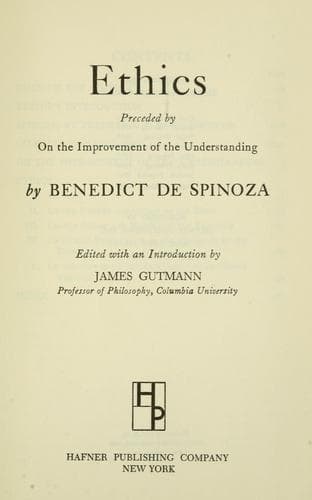
On the Improvement of the UnderstandingSpinoza, Benedictus de
PhilosophyPhilosophy
On the Improvement of the Understanding
Spinoza, Benedictus de
Free thought; Philosophy and religion
[61a] (1) Though I seem to deduce this from experience, some
may deny its cogency because I have given no formal proof.
(2) I therefore append the following for those who may
desire it. (3) As there can be nothing in nature contrary
to nature's laws, since all things come to pass by fixed
laws, so that each thing must irrefragably produce its own
proper effect, it follows that the soul, as soon as it
possesses the true conception of a thing, proceeds to
reproduce in thought that thing's effects. (4) See below,
where I speak of the false idea.
[64b] (1) Observe that fiction regarded in itself, only differs
from dreams in that in the latter we do not perceive the
external causes which we perceive through the senses while
awake. (2) It has hence been inferred that representations
occurring in sleep have no connection with objects external
to us. (3) We shall presently see that error is the dreaming
of a waking man: if it reaches a certain pitch it becomes delirium.
[76z] These are not attributes of God displaying His essence,
as I will show in my philosophy.
[76a] (1) This has been shown already. (2) For if such a being
did not exist it would never be produced; therefore the mind
would be able to understand more than nature could furnish;
and this has been shown above to be false.
[78a] (1) That is, it is known that the senses sometimes deceive us.
(2) But it is only known confusedly, for it is not known how
they deceive us.
[83d] (1) If the duration be indefinite, the recollection is
imperfect; this everyone seems to have learnt from nature.
(2) For we often ask, to strengthen our belief in something
we hear of, when and where it happened; though ideas
themselves have their own duration in the mind, yet, as we
are wont to determine duration by the aid of some measure
of motion which, again, takes place by aid of imagination,
we preserve no memory connected with pure intellect.
[91e] The chief rule of this part is, as appears from the first
part, to review all the ideas coming to us through pure
intellect, so as to distinguish them from such as we imagine:
the distinction will be shown through the properties of each,
namely, of the imagination and of the understanding.
[92f] Observe that it is thereby manifest that we cannot understand
anything of nature without at the same time increasing our
knowledge of the first cause, or God.
End of "On the Improvement of the Understanding."
Notes by Volunteer.
1. Used, in part, with kind permission from:
http://www.physics.wisc.edu/~shalizi/Spinoza/TIE/
Public-domain text, read in full here on John Shaqi.
Reviews
Reviews
No reviews yet
Be the first to share your thoughts on this work.
Join the Discussion
Join the discussion
Sign in to leave a comment or review.
Sign InorCreate an account