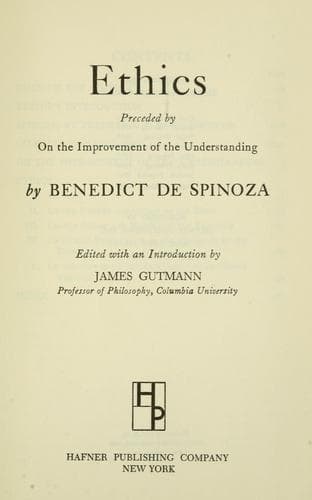
On the Improvement of the UnderstandingSpinoza, Benedictus de
PhilosophyPhilosophy
On the Improvement of the Understanding
Spinoza, Benedictus de
Free thought; Philosophy and religion
[18] (1) Having laid down these preliminary rules, I will betake
myself to the first and most important task, namely, the amendment
of the understanding, and the rendering it capable of understanding
things in the manner necessary for attaining our end. (2) In order
to bring this about, the natural order demands that I should here
recapitulate all the modes of perception, which I have hitherto
employed for affirming or denying anything with certainty, so that
I may choose the best, and at the same time begin to know my own
powers and the nature which I wish to perfect.
[19] (1) Reflection shows that all modes of perception or knowledge
may be reduced to four:--
I. (2) Perception arising from hearsay or from some sign which
everyone may name as he please.
II. (3) Perception arising from mere experience--that is, form
experience not yet classified by the intellect, and only so called
because the given event has happened to take place, and we have no
contradictory fact to set against it, so that it therefore remains
unassailed in our minds.
III. (19:4) Perception arising when the essence of one thing is inferred
from another thing, but not adequately; this comes when [f] from some
effect we gather its cause, or when it is inferred from some general
proposition that some property is always present.
IV. (5) Lastly, there is the perception arising when a thing is
perceived solely through its essence, or through the knowledge
of its proximate cause.
[20] (1) All these kinds of perception I will illustrate by examples.
(2) By hearsay I know the day of my birth, my parentage, and other
matters about which I have never felt any doubt. (3) By mere
experience I know that I shall die, for this I can affirm from
having seen that others like myself have died, though all did not
live for the same period, or die by the same disease. (4) I know
by mere experience that oil has the property of feeding fire, and
water of extinguishing it. (5) In the same way I know that a dog
is a barking animal, man a rational animal, and in fact nearly all
the practical knowledge of life.
[21] (1) We deduce one thing from another as follows: when we
clearly perceive that we feel a certain body and no other, we
thence clearly infer that the mind is united [g] to the body,
and that their union is the cause of the given sensation; but
we cannot thence absolutely understand [h] the nature of the
sensation and the union. (2) Or, after I have become acquainted
with the nature of vision, and know that it has the property of
making one and the same thing appear smaller when far off than
when near, I can infer that the sun is larger than it appears,
and can draw other conclusions of the same kind.
Public-domain text, read in full here on John Shaqi.
Reviews
Reviews
No reviews yet
Be the first to share your thoughts on this work.
Join the Discussion
Join the discussion
Sign in to leave a comment or review.
Sign InorCreate an account