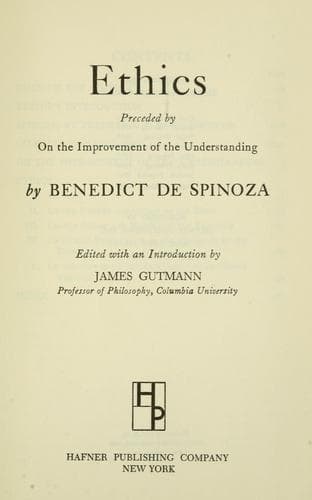
On the Improvement of the Understanding — John Shaqi
On the Improvement of the UnderstandingSpinoza, Benedictus de
PhilosophyPhilosophy
On the Improvement of the Understanding
Spinoza, Benedictus de
Free thought; Philosophy and religion
[22] (1) Lastly, a thing may be perceived solely through its essence;
when, from the fact of knowing something, I know what it is to know
that thing, or when, from knowing the essence of the mind, I know
that it is united to the body. (2) By the same kind of knowledge
we know that two and three make five, or that two lines each parallel
to a third, are parallel to one another, &c. (3) The things which I
have been able to know by this kind of knowledge are as yet very few.
[23] (1) In order that the whole matter may be put in a clearer
light, I will make use of a single illustration as follows.
(2) Three numbers are given--it is required to find a fourth,
which shall be to the third as the second is to the first.
(23:3) Tradesmen will at once tell us that they know what is required
to find the fourth number, for they have not yet forgotten the rule
which was given to them arbitrarily without proof by their masters;
others construct a universal axiom from their experience with simple
numbers, where the fourth number is self-evident, as in the case of
2, 4, 3, 6; here it is evident that if the second number be
multiplied by the third, and the product divided by the first,
the quotient is 6; when they see that by this process the number
is produced which they knew beforehand to be the proportional,
they infer that the process always holds good for finding a fourth
number proportional.
[24] (1) Mathematicians, however, know by the proof of the nineteenth
proposition of the seventh book of Euclid, what numbers are
proportionals, namely, from the nature and property of proportion
it follows that the product of the first and fourth will be equal
to the product of the second and third: still they do not see the
adequate proportionality of the given numbers, or, if they do see it,
they see it not by virtue of Euclid's proposition, but intuitively,
without going through any process.
[25] (1) In order that from these modes of perception the best may
be selected, it is well that we should briefly enumerate the means
necessary for attaining our end.
I. (2) To have an exact knowledge of our nature which we desire to
perfect, and to know as much as is needful of nature in general.
II. To collect in this way the differences, the agreements, and the
oppositions of things.
III. To learn thus exactly how far they can or cannot be modified.
IV. To compare this result with the nature and power of man.
(4) We shall thus discern the highest degree of perfection
to which man is capable of attaining.
Public-domain text, read in full here on John Shaqi.
Reviews
Reviews
No reviews yet
Be the first to share your thoughts on this work.
Join the Discussion
Join the discussion
Sign in to leave a comment or review.
Sign InorCreate an account