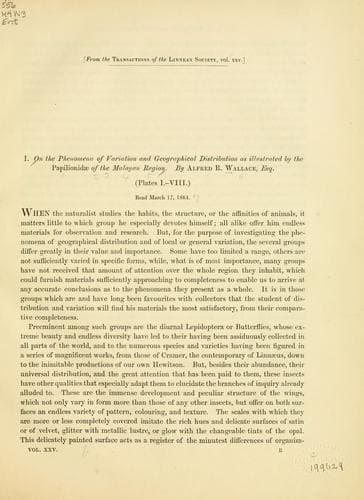
On the phenomena of variation and geographical distribution as illustrated by the Papilionidæ of the Malayan regionWallace, Alfred Russel
Science
On the phenomena of variation and geographical distribution as illustrated by the Papilionidæ of the Malayan region
Wallace, Alfred Russel
Papilionidae -- Malaysia -- Geographical distribution; Papilionidae -- Malaysia -- Variation
The Papilionidæ are a family of diurnal Lepidoptera which have hitherto,
by almost universal consent, held the first rank in the order; and
though this position has recently been denied them, I cannot altogether
acquiesce in the reasoning by which it has been proposed to degrade them
to a lower rank. In Mr. Bates’s most excellent paper on the
Heliconidæ[2], he claims for that family the highest position, chiefly
because of the imperfect structure of the fore legs, which is there
carried to an extreme degree of abortion, and thus removes them further
than any other family from the Hesperidæ and Heterocera, which all have
perfect legs. Now it is a question whether any amount of difference
which is exhibited merely in the imperfection or abortion of certain
organs, can establish in the group exhibiting it a claim to a high grade
of organization; still less can this be allowed when another group,
along with perfection of structure in the same organs, exhibits
modifications peculiar to it, together with the possession of an organ
which in the remainder of the order is altogether wanting. This is,
however, the position of the Papilionidæ. The perfect insects possess
two characters quite peculiar to them. Mr. Edward Doubleday, in his
‘Genera of Diurnal Lepidoptera,’ says, “The Papilionidæ may be known by
the apparently four-branched median nervule and the spur on the anterior
tibiæ, characters found in no other family.” The four-branched median
nervule is a character so constant, so peculiar, and so well marked, as
to enable a person to tell, at a glance at the wings only of a
butterfly, whether it does or does not belong to this family; and I am
not aware that any other group of Butterflies, at all comparable to this
in extent and modifications of form, possesses a character in its
neuration to which the same degree of certainty can be attached. The
spur on the anterior tibiæ is also found in some of the Hesperidæ, and
is therefore supposed to show a direct affinity between the two groups;
but I do not imagine it can counterbalance the differences in neuration
and in every other part of their organization. The most characteristic
feature of the Papilionidæ, however, and that on which I think
insufficient stress has been laid, is undoubtedly the peculiar structure
of the larvæ. These all possess an extraordinary organ situated on the
neck, the well-known =Y=-shaped tentacle, which is entirely concealed in
a state of repose, but which is capable of being suddenly thrown out by
the insect when alarmed. When we consider this singular apparatus, which
in some species is nearly half an inch long, the arrangement of muscles
for its protrusion and retraction, its perfect concealment during
repose, its blood-red colour, and the suddenness with which it can be
thrown out, we must, I think, be led to the conclusion that it serves as
a protection to the larva by startling and frightening away some enemy
Public-domain text, read in full here on John Shaqi.
Reviews
Reviews
No reviews yet
Be the first to share your thoughts on this work.
Join the Discussion
Join the discussion
Sign in to leave a comment or review.
Sign InorCreate an account