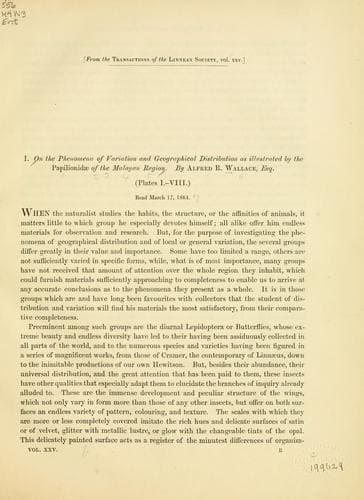
On the phenomena of variation and geographical distribution as illustrated by the Papilionidæ of the Malayan regionWallace, Alfred Russel
Science
On the phenomena of variation and geographical distribution as illustrated by the Papilionidæ of the Malayan region
Wallace, Alfred Russel
Papilionidae -- Malaysia -- Geographical distribution; Papilionidae -- Malaysia -- Variation
I find as a general rule that the constancy of species is in an inverse
ratio to their range. Those which are confined to one or two islands are
generally very constant. When they extend to many islands, considerable
variability appears; and when they have an extensive range over a large
part of the Archipelago, the amount of unstable variation is very large.
These facts are explicable on Mr. Darwin’s principles. When a species
exists over a wide area, it must have had, and probably still possesses,
great powers of dispersion. Under the different conditions of existence
in various portions of its area, different variations from the type
would be selected, and, were they completely isolated, would soon become
distinctly modified forms; but this process is checked by the dispersive
powers of the whole species, which leads to the more or less frequent
intermixture of the incipient varieties, which thus become irregular and
unstable. Where, however, a species has a limited range, it indicates
less active powers of dispersion, and the process of modification under
changed conditions is less interfered with. The species will therefore
exist under one or more permanent forms according as portions of it have
been isolated at a more or less remote period.
What is commonly called variation consists of several distinct phenomena
which have been too often confounded. I shall proceed to consider these
under the heads of—1st, simple variability; 2nd, polymorphism; 3rd,
local forms; 4th, coexisting varieties; 5th, races or subspecies; and
6th, true species.
Public-domain text, read in full here on John Shaqi.
Reviews
Reviews
No reviews yet
Be the first to share your thoughts on this work.
Join the Discussion
Join the discussion
Sign in to leave a comment or review.
Sign InorCreate an account