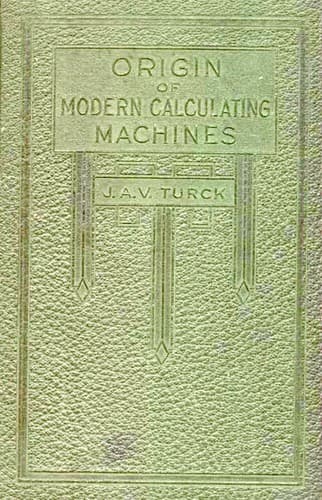
Origin of modern calculating machinesTurck, J. A. V.
History
Origin of modern calculating machines
Turck, J. A. V.
Calculators
[1] NOTE: The title of this book does not coincide with the above
argument, but in view of the common use of the term “calculating” its
application is better understood.
Considerable contention was raised by parties in a late patent suit as
to what constituted the make-up of a calculating machine. One of the
attorneys contended that construction was the only thing that would
distinguish a calculating machine. But as machines are named by their
functioning, the contention does not hold water. That is to say: A
machine may be a calculating machine and yet its construction be such
that it performs its functions of negative and positive calculation
without reversal of its action.
Again, a machine may be a calculating machine and operate in one
direction for positive calculation and the reverse for negative
calculation. As long as the machine has been so arranged that all forms
of calculation may be performed by it without mental computation, and
the machine has a reasonable capacity of at least eight orders, it
should be entitled to be called a calculating machine.
[Illustration: Drawings of Spalding Patent No. 293,809]
THE SPALDING MACHINE
The next machine that has any bearing on the key-driven Art of which
there is a record, is illustrated in a patent granted to C. G. Spalding
in 1884 (see illustration on opposite page). The Spalding invention,
like that of Bouchet, was provided with control for its primary
actuation and control for its secondary or carrying actuation.
[Sidenote: _Description of Spalding machine_]
Referring to the Spalding machine reproduced from the drawings of
his patent, the reader will note that in place of the units and tens
numeral wheels, a clock hand has been supplied, co-operating with a
dial graduated from 0 to 99, showing the figures 5, 10, 15, etc., to
95, for every five graduations.
Another similar hand or arrow and dial to register the hundreds is also
provided, having a capacity to register nineteen hundred. Attached to
the arrows, through a shaft connection at the back of the casing are
ratchet wheels, having respectively the same number of teeth as the
graduation of the dial to which each hand belongs.
Co-operating with the hundred-tooth ratchet of the units and tens
register hand is a ratchet and lever motion device (see Fig. 2) to turn
the arrow from one to nine points of the graduation of the dial. The
ratchet and lever motion device consists of the spring-pressed pawl E,
mounted on the lever arm D, engaging the hundred-tooth ratchet, the
link or push-rod F, the lever G, and its spring O. It will be noted
that a downward action of the lever G, will, through the rod F, cause
a like downward action of the lever D, causing the ratchet pawl E to
be drawn over the ratchet teeth. Upon the release of the lever G, the
spring O, will return it to its normal position and through the named
connecting parts, ratchet forward the arrow.
Public-domain text, read in full here on John Shaqi.
Reviews
Reviews
No reviews yet
Be the first to share your thoughts on this work.
Join the Discussion
Join the discussion
Sign in to leave a comment or review.
Sign InorCreate an account