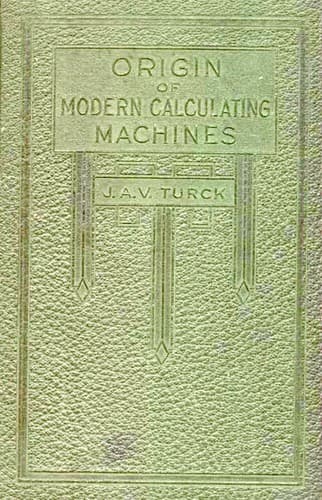
Origin of modern calculating machines — John Shaqi
Origin of modern calculating machinesTurck, J. A. V.
History
Origin of modern calculating machines
Turck, J. A. V.
Calculators
With such construction the nine-tooth gear may not rotate or become
displaced as long as the periphery of the disc continues to occupy
any one of the three convex spaces of the nine-tooth gear. When,
however, the notch of the disc is presented to the mutilated portion
of the nine-tooth gear, the said gear is unlocked. This unlocking
is coincident to the engagement of the single tooth of the numeral
wheel-gear with the nine-tooth gear and the passing of the numeral
wheel from 9 to 0, during which the nine-tooth gear will be moved three
spaces, and will be again locked as the notch in the disc passes and
the periphery fills the next convex space of the mutilated nine-tooth
gear.
[Sidenote: _Bouchet machine marketed_]
The Bouchet machine was manufactured and sold to some extent, but
never became popular, as it lacked capacity. Machines of such limited
capacity could not compete with ordinary accountants, much less with
those who could mentally add from two to four columns at a clip.
Aside from the capacity feature, there was another reason why these
single-order machines were useless, except to those who could not
add mentally. Multiple forms of calculation, that is, multiplication
and division, call for a machine having a multiplicity of orders.
The capacity of a single order would be but 9 × 9, which requires no
machine at all--a seven-year-old child knows that. To multiply 58964
× 6824, however, is a different thing, and requires a multiple-order
calculator.
[Sidenote: _Misuse of the term “Calculating Machine”_]
It is perhaps well at this time to point out the misuse of the term
calculating where it is applied to machines having only a capacity
for certain forms of calculating as compared with machines which
perform in a practical way all forms of calculation, that is,
addition, multiplication, subtraction and division. To apply the term
“calculating machine” to a machine having anything less than a capacity
for all these forms is erroneous.
An adding machine may perform one of the forms of calculation, but to
call it a calculating machine when it has no capacity for division,
subtraction or multiplication, is an error; and yet we find the U. S.
Patent Office records stuffed full of patents granted on machines thus
erroneously named. The term calculating is the broad term covering all
forms of calculation, and machines performing less should be designated
according to their specific capacities.
It is true that adding is calculating, and under these circumstances,
why then may not an adding machine be called a calculator? The answer
is that it may be calculating to add; it may be calculating to either
subtract, multiply or divide; but if a machine adds and is lacking in
the means of performing the other forms of calculation, it is only part
of a calculating machine and lacks the features that will give it title
to being a full-fledged calculator.[1]
Public-domain text, read in full here on John Shaqi.
Reviews
Reviews
No reviews yet
Be the first to share your thoughts on this work.
Join the Discussion
Join the discussion
Sign in to leave a comment or review.
Sign InorCreate an account