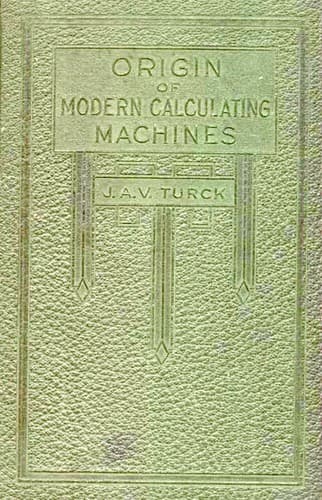
Origin of modern calculating machinesTurck, J. A. V.
History
Origin of modern calculating machines
Turck, J. A. V.
Calculators
Strength of design and construction, without the usual increase in
weight to attain such end, but above all, the absolute control of
momentum, were features that had to be worked out.
Robjohn partly recognized these features, but he limited the
application of such reasoning to the prime actuation of a single order,
and made nothing operable in a multiple key-driven machine.
Spalding and Bouchet recognized that the application of control was
necessary for both prime actuation and carrying, but, like Robjohn,
they devised nothing that would operate with a series of keys beyond a
single order.
[Sidenote: _Operative features necessary_]
An operative principle for control under prime actuation was perhaps
present in some of the single-order key-driven machines, but whatever
existed was applied to machines with keys arranged in the bank form
of construction, and, to be used with the keys in columnar formation,
required at least a new constructive type of invention. But none of
the means of control for carrying, prior to Felt’s invention, held any
feature that would solve the problem in a multiple-order machine.
[Sidenote: _Classification of the features contained in the early Art
of key-driven machines_]
While all the machines referred to have not been illustrated and
described here, fair samples of the type that have any pertinence
to the Art have been discussed, and those not illustrated would add
nothing more than has been shown. A classification of the inventions
referred to may be made as follows:
Parmelee and Stetner had no carrying mechanism; Hill, Robjohn,
Borland and Hoffman, Swem, Lindholm and Smith had no control for the
carry. Carroll, Bouchet and Spalding show a control for the carrying
action, which in itself would defeat the use of a higher wheel for
prime actuation, and which obviously would also defeat its use in a
multiple-order key-driven machine.
One of the principal reasons why theory was necessary to solve the
problem of the key-driven calculator existed in the impossibility
of seeing what took place in the action of the mechanism under the
lightning speed which it receives in operation. Almost any old device
could be made to operate if moved slow enough to see and study its
action; but the same mechanism that would operate under slow action
would not operate correctly under the lightning-speed action they
could receive from key depression. Only theoretical reasoning could be
used to analyze the cause when key-driven mechanism failed to operate
correctly.
[Sidenote: _Carrying mechanism of Felt’s calculator_]
Public-domain text, read in full here on John Shaqi.
Reviews
Reviews
No reviews yet
Be the first to share your thoughts on this work.
Join the Discussion
Join the discussion
Sign in to leave a comment or review.
Sign InorCreate an account