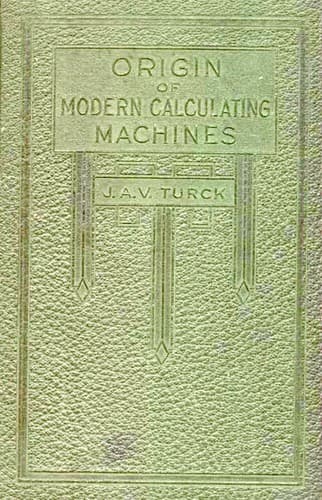
Origin of modern calculating machinesTurck, J. A. V.
History
Origin of modern calculating machines
Turck, J. A. V.
Calculators
Referring again to the drawings of the Felt patent, which illustrate
the first embodiment of a multiple-order key-driven calculating
machine, we find, what Felt calls in the claims and specifications,
a carrying mechanism for a multiple-order key-driven calculating
machine. This mechanism was, as set forth in the specification, a
mechanism for transferring the tens, which have been accumulated by
one order, to a higher order, by adding one to the wheel of higher
order for each accumulation of ten by the lower order wheel. This, in
the Felt machine, as in most machines, was effected by the rotation of
a numbered drum, called the numeral wheel, marked with the nine digits
and cipher.
[Sidenote: _Transfer devices_]
The term “transfer device” for such mechanism was in common use, and as
a term it fits certain parts of all classes of devices used for that
purpose, whether for a crank-driven, key-driven, or any other type
of multiple-order or single-order machine. But in the Felt invention
we find it was not the simple device generally used for transferring
the tens. It was, in fact, a combination of devices co-acting with
each other which, in the specification of the patent, was termed the
carrying mechanism.
[Sidenote: _Carrying mechanism versus mere transfer devices_]
Now, carrying mechanism may in a sense be termed a transfer device,
as one of its functions is that of transferring power to carry the
tens, but a mere transfer device may not be truthfully termed a
carrying mechanism for a multiple-order key-driven machine unless it
performs the functions that go to make up a correct carrying of the
tens in that class of machine, and which we find laid down under the
head of carrying mechanism in the Felt patents, where we find the
first operative carrying mechanism ever invented for a multiple-order
key-driven machine.
The functions demanded of such a piece of mechanism are as follows:
First, the storing of power to perform the carry; second, the
unlocking of the numeral wheel to be carried; third, the delivery
of the power stored to perform such carry; fourth, the stopping and
locking of the carried wheel when it has been moved to register such
carry; and fifth, clearing the carrying-lock during prime actuation. A
seemingly simple operation, but let those who have tried to construct
such mechanism judge; they at least have some idea of it and they will
no doubt bow their heads in acknowledgment of the difficulties involved
in this accomplishment.
Mechanism for carrying the tens in single digit adders was one thing,
and such as was used could well be called a transfer device; but
mechanism for carrying the tens in a real key-driven calculating
machine was another thing, and a feature not solved until Felt
solved it, and justly called such combination of devices a “carrying
mechanism.”
[Sidenote: _Details of Felt carrying mechanism_]
Public-domain text, read in full here on John Shaqi.
Reviews
Reviews
No reviews yet
Be the first to share your thoughts on this work.
Join the Discussion
Join the discussion
Sign in to leave a comment or review.
Sign InorCreate an account