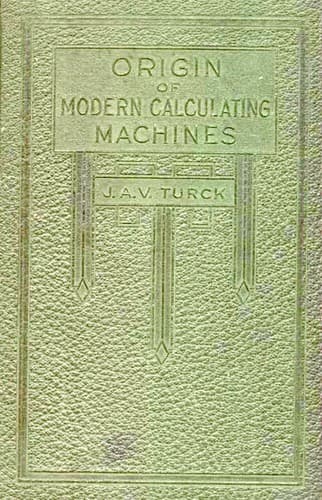
Origin of modern calculating machinesTurck, J. A. V.
History
Origin of modern calculating machines
Turck, J. A. V.
Calculators
The paper is supplied from a roll mounted on a hinged platen frame P¹,
supported in its normal position by a spring P³. The paper passes under
the roller P, which acts as a platen for the impression of the type. A
shaft Q, passing under the frame P¹, is fast and rigidly connected on
the left-hand side of the machine with the hand lever R, and acts as a
pivot for the said lever and by means of lateral projections q, serves
when the lever R is operated to engage the frame P¹, and depresses it
until the needle types have pricked the numerical items through the
paper.
A slit in the casing provided means for printing the item on a separate
piece of paper or bill.
Although there is no means shown by which the paper is fed after an
item is printed, it is claimed in the specification that the well-known
means for such feeding may be employed. The actuating lever J referred
to, is connected by a ratchet and geared action with the shaft F[3],
so that a revolution is given the said shaft each time the lever is
operated.
[3] NOTE: All the drawings of the Pottin patent are not shown here.
To the shaft F, (see Fig. 1) is attached a series of arms H, one for
each order, which, as the shaft revolves in the direction of the arrow,
engages a lug marked I, on the segmental racks D, thus rocking the
segments back to normal, turning the type-wheels with them.
The return of the segment racks D, cause the back of the latch-tooth
f¹, (see Fig. 8) to engage the latch-tooth f, of the latch bar E,
camming it out of engagement with the keys so that any key that has
been set will return by means of its own spring.
[Illustration]
[Illustration: From Drawings of Burroughs Patent No. 388,118]
[Illustration: Wm. S. Burroughs]
The total or accumulator numeral wheels are connectable with the type
or indicating wheels B, by an engaging and disengaging gear motion set
up by the combined action of the hand levers R and J, which first cause
such gear engagement, and then, through the return of the type wheels
to zero, turn the accumulator wheels, thus transferring the amount of
the item set upon the type wheels to the accumulator wheels.
The specification claims the machine is intended for use by cashiers,
bank-tellers, and others, to record receipts or disbursements.
It is also claimed in the specification that instead of the needle type
ordinary type may be used in combination with an inking ribbon if so
desired.
[Sidenote: _Early efforts of Wm. S. Burroughs_]
One of the next attempts to produce a recording-adder was made by Wm.
S. Burroughs, whose name sixteen years later was used to rename the
American Arithmometer Co., now known as the Burroughs Adding Machine Co.
The first patent issued to Burroughs, No. 388116, under date of August
21, 1888, like the machine of Barbour and Baldwin, was designed to
record only the final result of calculation.
Public-domain text, read in full here on John Shaqi.
Reviews
Reviews
No reviews yet
Be the first to share your thoughts on this work.
Join the Discussion
Join the discussion
Sign in to leave a comment or review.
Sign InorCreate an account